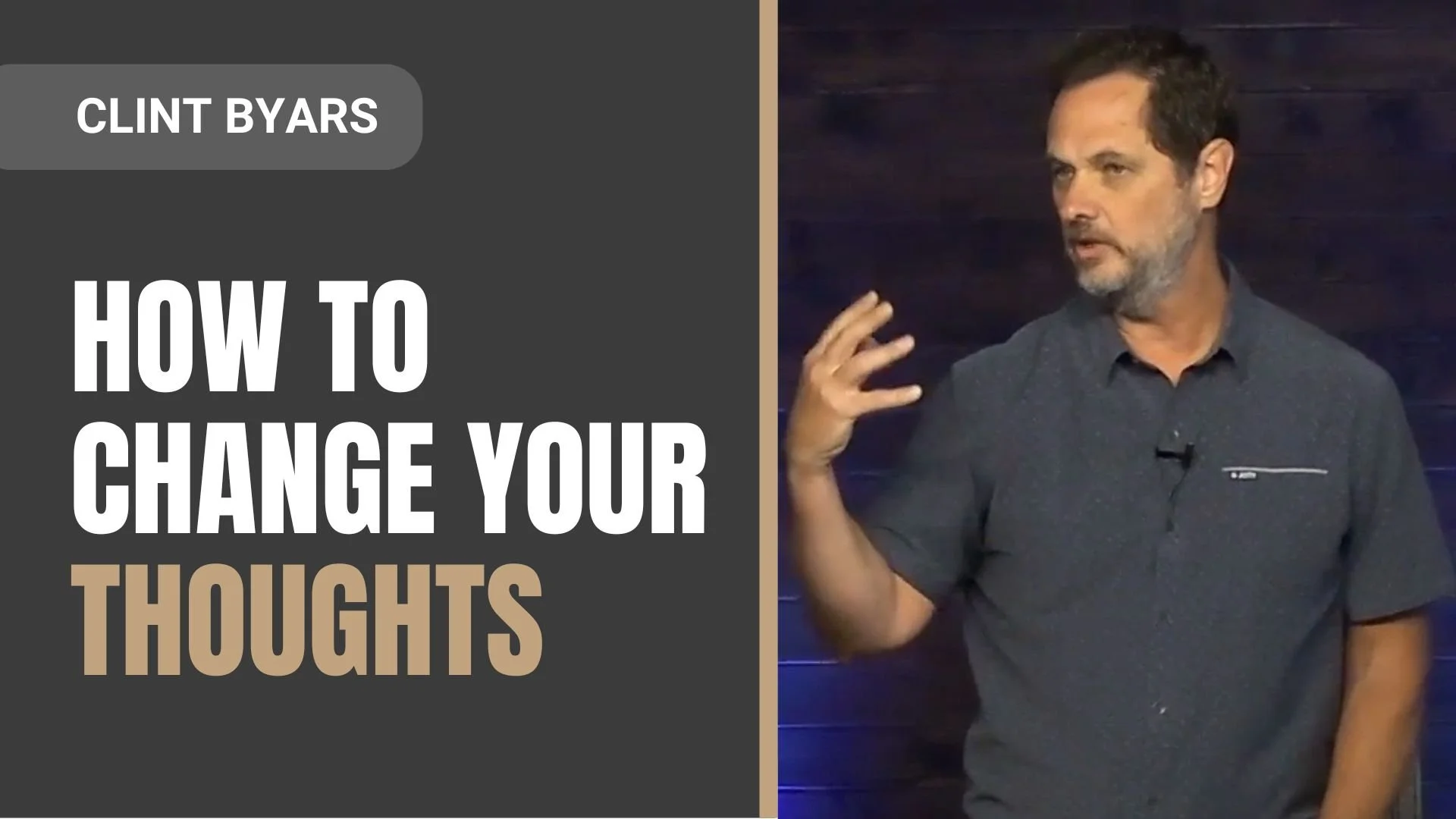
Change Your Thoughts, Change Your Life
The cross is the lens everything else should be filtered through, and your real fight is usually with a destructive thought loop, not an outside force — so when a hard thought hits, name it and replace it with truth (rejection with acceptance, guilt with forgiveness, shame with grace). Isaiah 53 spells out that trade in detail, showing how his suffering directly answers your specific struggles. And don't keep asking "what's wrong with me" — your mind finds whatever evidence you keep hunting for, so choose to see your same circumstances through a hope-filled lens instead.
You Don't Have to Believe Every Thought You Think
Ever notice how a bad thought can snowball? One small "what's wrong with me" turns into a full-blown spiral before lunch. Here's the good news: you're not stuck with those thoughts, and you're not fighting them alone.
That's the heart of a simple but powerful idea: everything you believe about God, and about yourself, has to be filtered through what Jesus did on the cross. Not as a slogan you nod along to, but as the actual lens you run your thoughts through when life gets loud.
The One Thing Everything Else Builds On
Scripture, church history, doctrine — all of it matters. But there's one center of gravity holding it together: the death, burial, and resurrection of Jesus. Every question you're wrestling with, every fear, every "why is this happening" — it's all meant to be understood in light of what happened at the cross. That's not the whole Bible reduced to one idea; it's the foundation everything else is built on.
Your Real Fight Isn't With Demons — It's With a Thought Loop
Here's a shift in perspective worth sitting with: the "spiritual warfare" described in 2 Corinthians 10 isn't primarily about casting out evil spirits. It's about tearing down strongholds — and a stronghold is just a repeating, destructive way of thinking. Things like:
"I always attract this kind of situation."
"I don't deserve this."
"Something's wrong with me."
That loop, left unchecked, is what the passage calls carnal thinking — thinking that leads to death, not because you're a bad person, but because it's disconnected from the truth. The fix isn't gritting your teeth harder. It's taking the thought captive — noticing it, naming it, and refusing to let it run the show.
So what do you replace it with? This is the key move: you bring the thought into line with what Christ was obedient to — his death on the cross. Practically, that looks like:
Condemnation gets answered by righteousness.
Fear gets answered by perfect love.
Shame gets answered by forgiveness.
Rejection gets answered by reconciliation.
Hopelessness gets answered by the hope of eternal life.
You're not pretending the hard feeling isn't there. You're just refusing to let it have the final word.
Isaiah 53: A Snapshot of the Trade
Isaiah wrote this roughly 700 years before Jesus was born, and it maps the cross with eerie precision. Strip away the specific verses and you're left with one simple exchange, repeated over and over:
He was rejected — so you could be accepted.
He carried grief — so your grief could be met, not ignored.
He was wounded — so guilt and condemnation lose their grip on you.
He was silent under false accusation — so you don't have to defend or perform your worth.
He was cut off — so no place you've ever been, emotionally or otherwise, is a place he hasn't already gone to break its power.
None of this erases real pain — grief is still grief, loss is still loss. But it means you're never carrying it solo, and it's never the deepest truth about you.
Don't Talk to Yourself Like Someone Who Isn't Loved Like This
If you wouldn't let a friend talk to you the way you talk to yourself, that's worth noticing. Beating yourself up isn't humility — it's actually a mismatch with what all of this claims is true about you. You're not disqualified. You're not too far gone. You're not the exception. That's a hard thing to actually believe in the middle of a bad week, but it's the whole point.
Watch What Question You're Asking Yourself
There's a subtler trap worth naming: asking "what's wrong?" on repeat. It sounds harmless, even self-aware. But your mind will always find an answer to the question you keep asking it. Ask "what's wrong with me" enough times, and you'll start seeing evidence for it everywhere — in your relationships, your job, your body, your past decisions. It becomes a self-fulfilling filter.
The alternative isn't denial. It's asking a better question: what does the truth say here, not just my circumstances? That's the difference between carnal thinking (only what you can see and figure out on your own) and spiritual thinking (holding onto a promise even when you don't yet see how it works out).
Send Me Everything You've Got
There's an old story about two salesmen sent to an island where nobody wears shoes. One calls home defeated: "Waste of time, nobody needs shoes here." The other calls back thrilled: "Nobody has shoes — send me everything you've got, this is the opportunity of a lifetime."
Same island. Same facts. Completely different outlook — because they were looking at the same thing through a different lens. That's the invitation here: you already carry everything you need on the inside. The question is just which lens you're looking through today.
Takeaways
Everything you believe about God and yourself should be filtered through the cross — it's the foundation, not just one topic among many.
Your real battle is usually with a thought pattern, not an outside force. Name the loop instead of just feeling stuck in it.
"Taking a thought captive" means noticing the destructive thought and deliberately replacing it with truth — condemnation with righteousness, fear with love, shame with forgiveness, rejection with reconciliation, hopelessness with hope.
The exchange at the cross applies personally: rejection, grief, guilt, and isolation were all addressed there.
Don't talk to yourself in a way you wouldn't accept from someone else.
Be careful what question you keep asking yourself — "what's wrong with me" tends to manufacture its own evidence.
Same circumstances, different lens, completely different life. You get to choose which one you're using.
Try This
Next time a hard or self-critical thought shows up, don't just push through it — interrupt it on purpose:
Name it. Say what the thought actually is: "I'm thinking I'm not enough," or "I'm thinking this is my fault."
Ask the real question. Not "what's wrong with me," but "what's actually true here?"
Replace it, out loud if you can. Pick the matching truth — "I'm forgiven," "I'm not carrying this alone," "This isn't the final word" — and say it like you mean it, even before it fully feels true.
That's it. Small, repeatable, and it works exactly because it's simple.
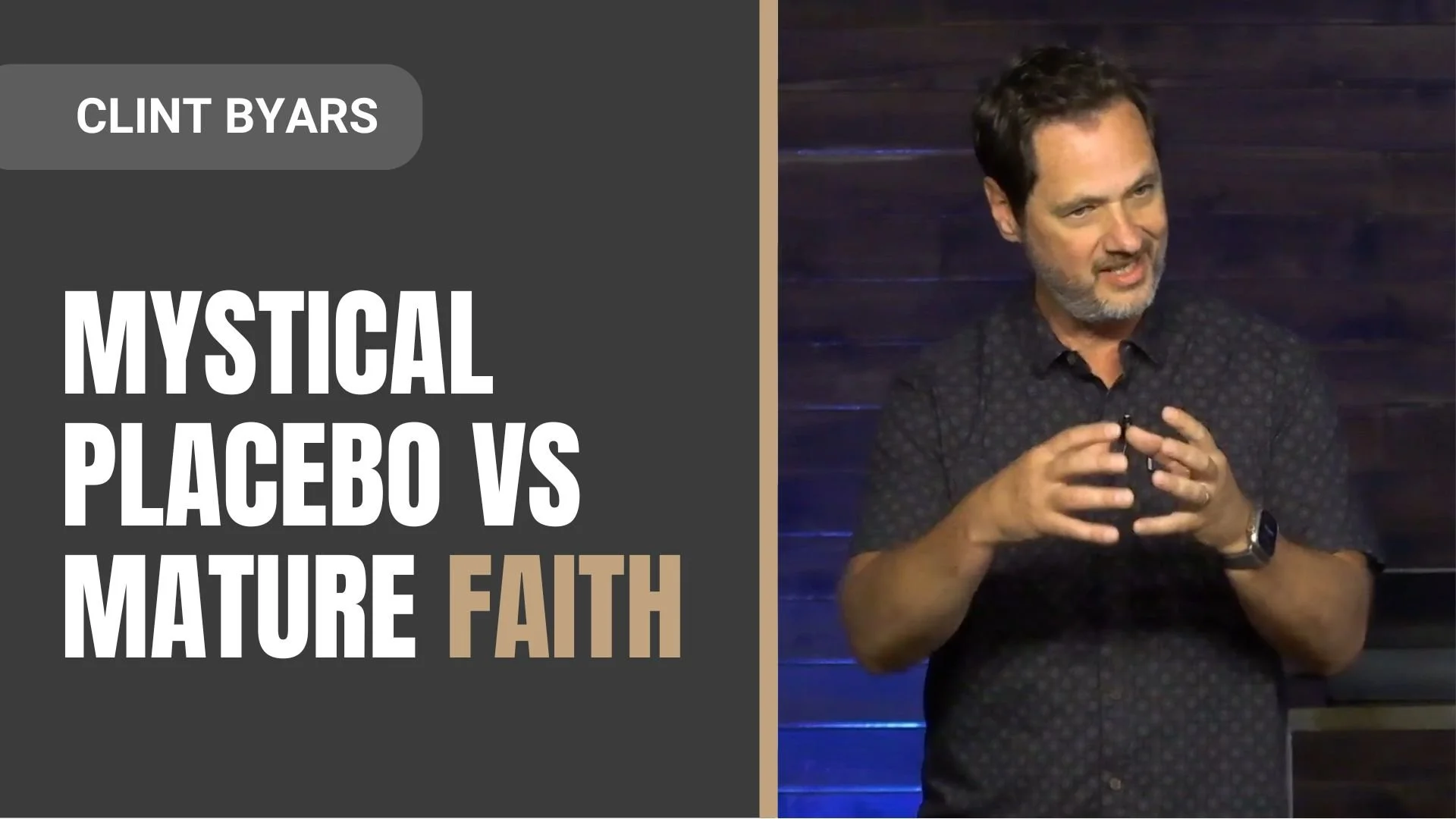
Mystical Placebo vs Mature Faith
A mystical placebo is any ritual, special anointing, or spiritual condition inserted between you and what Christ has already provided — and like a sugar pill in a clinical trial, it can appear to work because your faith and expectation finally had somewhere to land, not because the ritual itself had any power. The trap is that you walk away dependent on the mechanism instead of the source, endlessly chasing the next evangelist, the next formula, or the next loophole to unlock what Jesus already paid for in full. Mature faith cuts through all of it — rooted in the finished work of Christ, it simply recognizes that healing, freedom, and abundant life aren't rewards you earn through the right spiritual steps, but a reality you receive by becoming fully persuaded that he who promised is faithful.
What Is a Placebo and What Makes One "Mystical"?
A placebo is something that has no actual medicinal power, but because you believe it does, it works anyway.
Here's the classic example: In a clinical drug trial, researchers give half the participants the actual medication and the other half a simple sugar pill, a fake. The sugar pill has zero pharmacological effect. And yet, time and again, some of the people who took the sugar pill experience the same results as those who took the real drug. Not because the pill did anything. Because they believed it would.
This is medically verified. It's documented. It's real.
Now, God wired us this way. Your beliefs have genuine power over your physical and emotional reality. What you keep saying shapes what you keep expecting. What you keep expecting shapes what you experience. That's not mysticism. That's how we're made.
But here's where it gets dangerous in the church.
A mystical placebo is when a spiritual condition, ritual, or authority figure gets inserted between you and what Christ has already provided, and people get results not because the ritual worked, but because their faith and expectation finally had somewhere to land.
The "miracle" was real. But the mechanism was misidentified.
The Lineup of Mystical Placebos
They show up in more forms than you might think.
Special anointings. The idea that certain teachers or evangelists carry a supernatural power that you don't have, and if you can just get under their ministry, receive their impartation, or align yourself under the right covering, then you'll get what God has for you. This is textbook Gnosticism — the ancient heresy that plagued the early church and that Paul and John wrote letters to combat. The word "Gnosticism" comes from the Greek gnosis, meaning knowledge. The pursuit of the missing piece. The special information that will finally make you complete.
Healing pools and blessed objects. Think of the Pool of Siloam, where the legend held that an angel would stir the waters and the first person in would be healed. People were healed there. But were they healed because of the water, or because the water gave their faith somewhere to focus? There's a difference. And confusing the two is how people end up writing $770 checks on the seventh day of the seventh month at 7 PM because someone told them God attached a tenfold blessing to that specific combination.
"You can't be healed until you forgive." This one is especially pervasive in inner healing circles. The idea is that an unresolved soul tie, a generational curse, or unforgiveness gives the enemy a "legal right" to block your healing. On and on the list goes: your grandfather was a mason, you said a bad word after stubbing your toe, you've slept with too many people. There's no end to the mystical legal loophole. You can spend your whole life trying to diagnose the spiritual technicality that's standing between you and your breakthrough.
And exhausting doesn't begin to cover it.
Why It "Works"
Here's what makes mystical placebos so hard to call out: people actually get healed through them.
The evangelist prays, the crowd erupts, someone's pain disappears. The baptism pool fills up, someone goes under, they come out changed. The oil-soaked Bible gets pressed to a forehead, and something happens.
So how do you argue with results?
Very carefully, because the results are real, but the explanation may be wrong.
When someone creates an environment of expectation — if I can just get to that service, if I can just get in that water, if I can just get that man of God to pray for me — they have, whether they know it or not, done something powerful. They have persuaded their own heart. They have built up hope to the point of confident expectation. And when a heart is fully open, the healing that Christ already paid for can finally find a place to land.
The miracle came from Christ. But the person was told it came from the ritual. And now they're dependent on the ritual, and on the person or process that provides it.
That's the trap.
The Woman with the Issue of Blood
Mark 5 gives us the clearest picture of how this actually works.
A woman had been bleeding for twelve years. She'd spent everything she had on doctors. She was ceremonially unclean, which meant she wasn't legally allowed in public, let alone touching a man. Approaching Jesus in that crowd could have gotten her arrested. Could have gotten her stoned.
And yet she came.
"When she heard about Jesus, she came up through the crowd behind him and touched his cloak. For she kept saying, 'If only I touch his garments, I will be healed.'"
Notice what she kept saying. She was programming her heart. She was building expectation, layer by layer, through repetition of a belief she was still in the process of owning.
And then: "Immediately her bleeding stopped, and she sensed in her body that she was healed of her affliction."
She took it. Jesus didn't see her coming and decide to heal her. He didn't even know who touched him. "At once Jesus was aware that power had gone out from him. Turning to the crowd, he asked, 'Who touched my garments?'"
Power went out from him because she drew from him. He is the source, not his garment — not a placebo, not a symbol, but the actual thing. And she accessed it through faith before he ever made a conscious decision in her direction.
His response when he finally found her?
"Daughter, your faith has healed you. Go in peace and be free from your affliction."
Not: "Good thing you touched me." Not: "Your ritual worked." Not: "You finally found the right loophole."
Your faith has healed you.
Now, she did put a stipulation on it. If only I touch him. What if she had believed from her sick bed, without ever reaching the crowd? Would healing have been just as available? Almost certainly. She may have received through a slightly more elaborate path than necessary, but she got there. The mechanism that actually mattered was the persuasion of her heart.
Faith Is Not What You Do to Get God to Move
This is the hinge point that changes everything.
Faith is not an action you perform to trigger a divine response. It's not the lever you pull. It's not the checklist you complete. It's not even the feeling you have to manufacture.
"Now faith is the substance of things hoped for, the evidence of things not seen." — Hebrews 11:1
Faith is the foundation. It's the bedrock that opens your heart to receive what is already present and available. Think of it like a building: faith pours the foundation — Christ, the solid rock. Then hope — confident expectation, not wishful thinking — begins to build on that foundation.
Hope is not "I really wish this would happen." Hope is: He died for this. He overcame sin. He destroyed death. He took my diseases on that cross. I don't care what my body is saying right now. He is a healer. That is settled.
Nobody can argue you out of that. No bad test result shakes it. No symptom distracts it. It is resolute.
Why do you have the right to that kind of confidence? Because he is the source. The question is never whether he's able or willing. The question is always how clearly you see him.
Sarah and the Tipping Point
Consider Abraham and Sarah. God spoke the promise: through you will come a blessing that blesses all nations, you will have a child, and then nothing happened for twenty-five years.
The promise was real. The promise was present. It was, in a sense, hanging in the air, charged and available, trying to find a place to land in her heart. But until Sarah judged him faithful — until she fully believed that the one who promised was actually capable of delivering — she couldn't receive it.
"He who promised is faithful." — Hebrews 10:23
That was the tipping point. Not a ritual. Not a confession formula. Not a special impartation. She finally saw him clearly. And the moment she did, what he had spoken from the beginning simply became her reality.
God didn't withhold the promise until she believed. She couldn't receive it until she did.
So What Do We Actually Do?
Keep saying the truth, not to make it happen, but until you actually believe it.
Confession isn't a magic formula to trigger God's action. It's the discipline of repeatedly presenting truth to your own heart until your heart finally accepts it. By his stripes, you were healed. He is your provider. He is faithful. Not "will be" — is. You're not trying to move him. You're trying to get yourself to believe that he's already moved.
Repentance, in its deepest sense, isn't just apologizing — it's seeing him clearly. And when you see him clearly, something happens that you can't fully explain or manufacture: you become like what you behold. When you see him as merciful, you become merciful. When you know you're forgiven, you can forgive. When you see him as a healer who wants you well, your heart opens and lets the healing through that was always there.
You are not a project God is stalling on. You are not a loophole he's waiting to close. You are not incomplete, unchurched enough, or under the wrong covering.
You are complete in him. The anointing abides. His Spirit is in you. The same power that raised Jesus from the dead is at work in your physical body right now.
Stop chasing. Start receiving.
"Let us hold resolutely to the hope we profess, for he who promised is faithful." — Hebrews 10:23
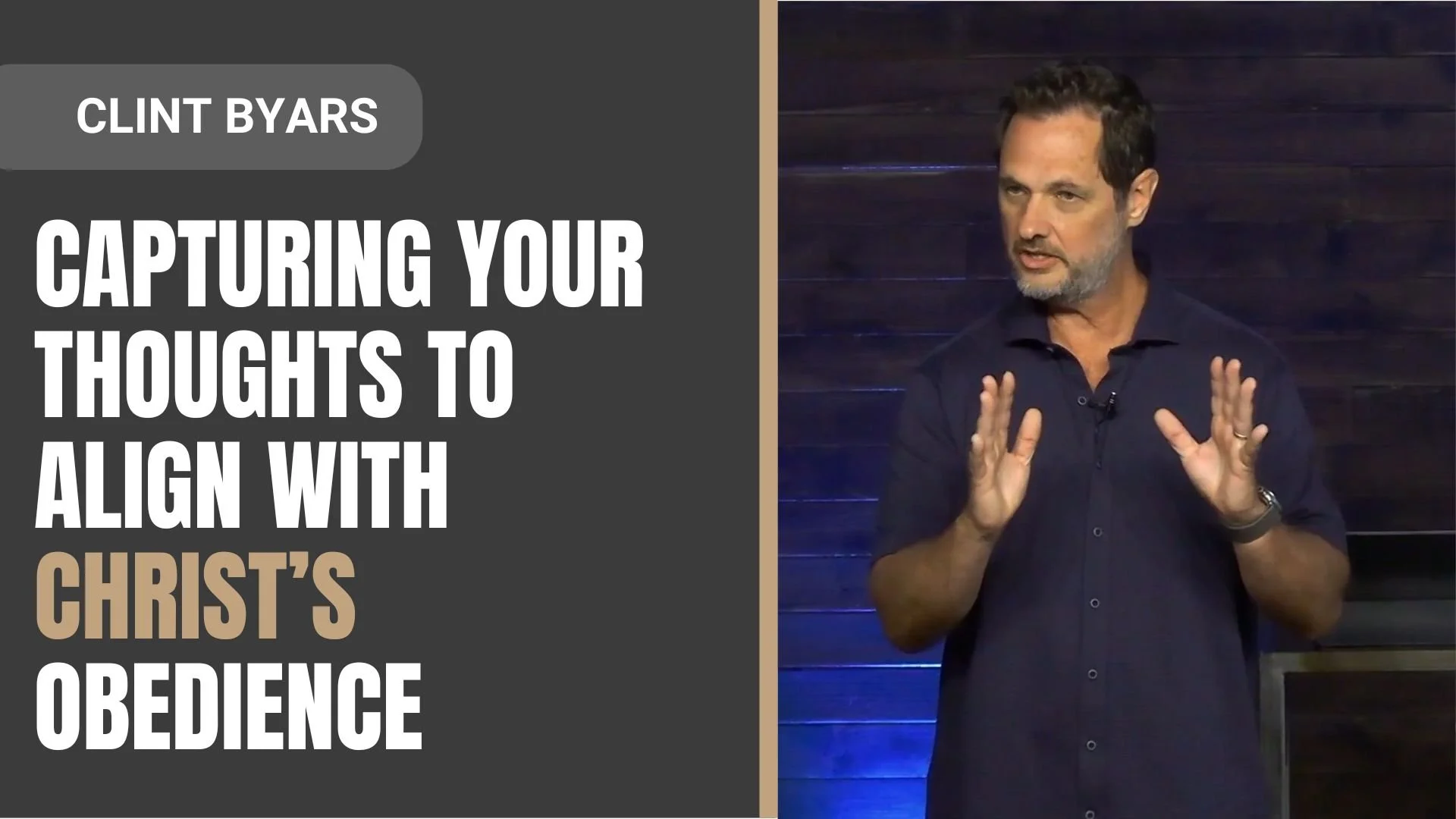
What Does it Mean to Bring Your Thoughts Captive to Christ’s Obedience?
Through the death, burial, resurrection, and Pentecost, God made it possible not only to forgive us but to remove our old sinful nature, give us a new heart, place His Spirit within us, and make us new creations in Christ. Because God's Spirit now lives in us, we are no longer victims of our thoughts but have the ability to bring every thought captive and evaluate it in light of what Jesus accomplished through His obedience on the cross. Lasting transformation happens when we consistently replace thoughts that contradict the Gospel with the truth of who God is, what Christ has done, and who we now are in Him.
Capturing Thoughts and Living in Freedom
Pentecost was more than a dramatic moment in the book of Acts. It marked a permanent change in how God relates to humanity. Before Christ's death and resurrection, the Spirit of God would come upon prophets, priests, and kings for specific purposes. Under the New Covenant, God fulfilled His promise to put His Spirit within His people (Ezekiel 36:25-27; Jeremiah 31:33; Acts 2:1-4).
Jesus instructed His disciples to wait for "the Promise of the Father" (Acts 1:4-5). That promise was not merely power—it was presence. The Spirit of God would no longer simply rest upon His people. He would dwell within them.
"Pentecost marked the day when God changed locations and moved into His believers."
This truth changes everything about how we view ourselves. We are not trying to get God to come near. Through Christ, He has already made His home within us. Paul asks the question in 1 Corinthians 6:19, "Do you not know that your body is the temple of the Holy Spirit who is in you?" The presence that once filled the tabernacle and the temple now lives within every believer.
The Christian life begins with understanding that God is not distant. He is present. He is near. He is in you.
What God Did in You
When you believed the Gospel, God did more than forgive your sins. He performed a supernatural work in your spirit. Colossians 2:11-13 describes this as a spiritual circumcision, a removal of the old sinful nature. Ezekiel prophesied that God would remove the heart of stone and give us a heart of flesh (Ezekiel 36:26).
The old nature that was dead in sin was removed. Through the blood of Christ, you were washed, cleansed, sanctified, and made alive in Him (Hebrews 10:10, 14; Titus 3:5; Ephesians 2:4-6).
"You are not a sinner trying to become righteous. Through faith in Christ, you have been made righteous and are learning to live from that reality."
God did not merely improve the old you. He created something entirely new.
2 Corinthians 5:17 declares:
"If anyone is in Christ, he is a new creation; old things have passed away; behold, all things have become new."
The Gospel is not behavior modification. It is spiritual transformation.
The Battle Is Not Your Thoughts—It's Your Agreement
Every person experiences unwanted thoughts. Fearful thoughts. Tempting thoughts. Condemning thoughts. The presence of a thought does not define you. What defines you is whether you choose to agree with it.
Scripture teaches that believers have the ability to bring thoughts into captivity (2 Corinthians 10:3-5). This means we are not helpless victims of our thinking. Through the Spirit of God, we can evaluate every thought and determine whether it belongs in our lives.
"You cannot stop every thought from arriving, but you can stop it from taking root."
A stronghold is not merely a demonic attack. A stronghold is a belief that has become established in the heart and exalts itself against the knowledge of God. The enemy may reinforce that lie, but the lie itself is what must be torn down.
This is why mind renewal is so important. Transformation begins when truth becomes more believable than the lie.
Bringing Every Thought to the Cross
Paul tells us to bring every thought captive to the obedience of Christ (2 Corinthians 10:5). Many believers read that verse and assume it means making their thoughts obey Jesus. While that is partly true, there is something deeper taking place.
Romans 5:19 says:
"By one Man's obedience many will be made righteous."
The obedience of Christ refers to His obedience unto death, even the death of the cross (Philippians 2:8).
Every thought should be evaluated in light of what Jesus accomplished through His obedience.
When fear says, "God has abandoned me," we bring that thought to the cross. Jesus suffered to reconcile us to the Father (Romans 5:10). Therefore, that thought is a lie.
When shame says, "I am unworthy," we bring that thought to the cross. Jesus became sin so that we might become the righteousness of God in Him (2 Corinthians 5:21). Therefore, that thought is a lie.
When temptation says, "This is who I am," we bring that thought to the cross. Christ crucified the old man and raised us into newness of life (Romans 6:4-6). Therefore, that thought is a lie.
"Take every thought through the death, burial, and resurrection of Jesus until it agrees with what He accomplished."
That is how strongholds lose their power.
Your Heart Determines Your Reality
Scripture consistently teaches that the heart is the center of belief.
"As a man thinks in his heart, so is he" (Proverbs 23:7).
"Guard your heart with all diligence, for out of it spring the issues of life" (Proverbs 4:23).
The beliefs that take root in your heart shape how you see yourself, how you interpret circumstances, and how you respond to temptation, fear, and adversity.
If your heart is convinced that God loves you, you will respond differently to life's challenges.
If your heart is convinced that you are accepted in Christ, condemnation loses its influence.
If your heart is convinced that you are a new creation, sin loses much of its appeal.
"The battle is not merely about behavior. The battle is about what feels true in your heart."
This is why meditation on God's Word is so powerful. It moves truth from information into conviction.
Think on These Things
Paul gives believers a practical filter for every thought:
"Whatever things are true, whatever things are noble, whatever things are just, whatever things are pure, whatever things are lovely, whatever things are of good report... meditate on these things" (Philippians 4:8).
Every thought that enters your mind can be examined through these questions:
Is this true?
Does this agree with what Jesus accomplished?
Does this align with who God says I am?
Does this produce faith, hope, and love?
Does this magnify Christ or diminish Him?
"If a thought does not agree with the finished work of Jesus, it does not deserve permanent residence in your mind."
The goal is not positive thinking. The goal is agreement with truth.
As God's truth becomes established in your heart, peace begins to replace anxiety, confidence begins to replace fear, and freedom begins to replace bondage.
This is the pathway of transformation.
This is what it means to bring every thought captive to the obedience of Christ.