Yom Kippur: A Shadow of Eternal Redemption in Christ and the removal of Sin
Cleansed for His Presence: From Yom Kippur to Eternal Redemption in Christ
How the Day of Atonement Foreshadowed Our New Nature, Eternal Redemption, and Christ's Victory Over Darkness
These two standalone messages explore Yom Kippur, the Jewish Day of Atonement, and how its sacrifices foreshadowed the eternal redemption we have in Jesus Christ. The two goats, the cleansing of the tabernacle, and the ministry of the high priest reveal something greater than temporary forgiveness. They point to the removal of our old sinful nature, our sanctification through the blood of Christ, and our transformation into the dwelling place of the Holy Spirit.
These messages also establish the foundation for our October 2026 series examining the dark spiritual forces operating in the world, including deception, witchcraft, and demonic influences. Before examining darkness, we must establish the supremacy of Jesus, who has conquered death, secured our eternal redemption, and disarmed the powers of darkness.
1. Yom Kippur: The Shadow of Eternal Redemption
When we study the Old Testament, we should always be looking for Jesus. The law, priesthood, sacrifices, and tabernacle were all pointing toward something greater that God would accomplish through Christ. We do not study these things to live under the old covenant but to discover the depth of what Jesus accomplished through His finished work.
Yom Kippur means the Day of Atonement. Under the Mosaic covenant, it was the annual day when the high priest carried out sacrifices and cleansing rituals on behalf of Israel. Leviticus 16 describes the ceremony, while Hebrews 9 and 10 explain how these sacrifices foreshadowed Christ.
To understand atonement, we must understand humanity's greatest problem. We tend to focus primarily on sin, but the deeper problem Jesus came to address was death. God created humanity for life and fellowship with Himself. When humanity turned away from Him, sin entered our experience, bringing spiritual death and separation from the source of life. We could not restore that connection ourselves. God had to remove what separated us from Him, bring us from death to life, and make us capable of being joined to Him eternally.
Leviticus 17:11 tells us that the life of the flesh is in the blood and that God gave the blood upon the altar to make atonement for the soul. The sacrifice represented an exchange of life, temporarily providing for Israel under the old covenant and pointing toward the perfect life Jesus would offer on our behalf.
On the Day of Atonement, the high priest had to wash, put on the prescribed garments, and offer a sacrifice for himself before ministering on behalf of Israel. This foreshadowed Jesus, who lived a perfect, sinless life and was qualified to become our sacrifice. Unlike the Levitical priests, Jesus needed no sacrifice for His own sin.
Central to the ceremony were two goats. One was offered to the Lord as a sin offering, and its blood was taken into the Most Holy Place. The other goat remained alive. The high priest laid both hands upon its head, confessed Israel's sins over it, and sent it away into the wilderness.
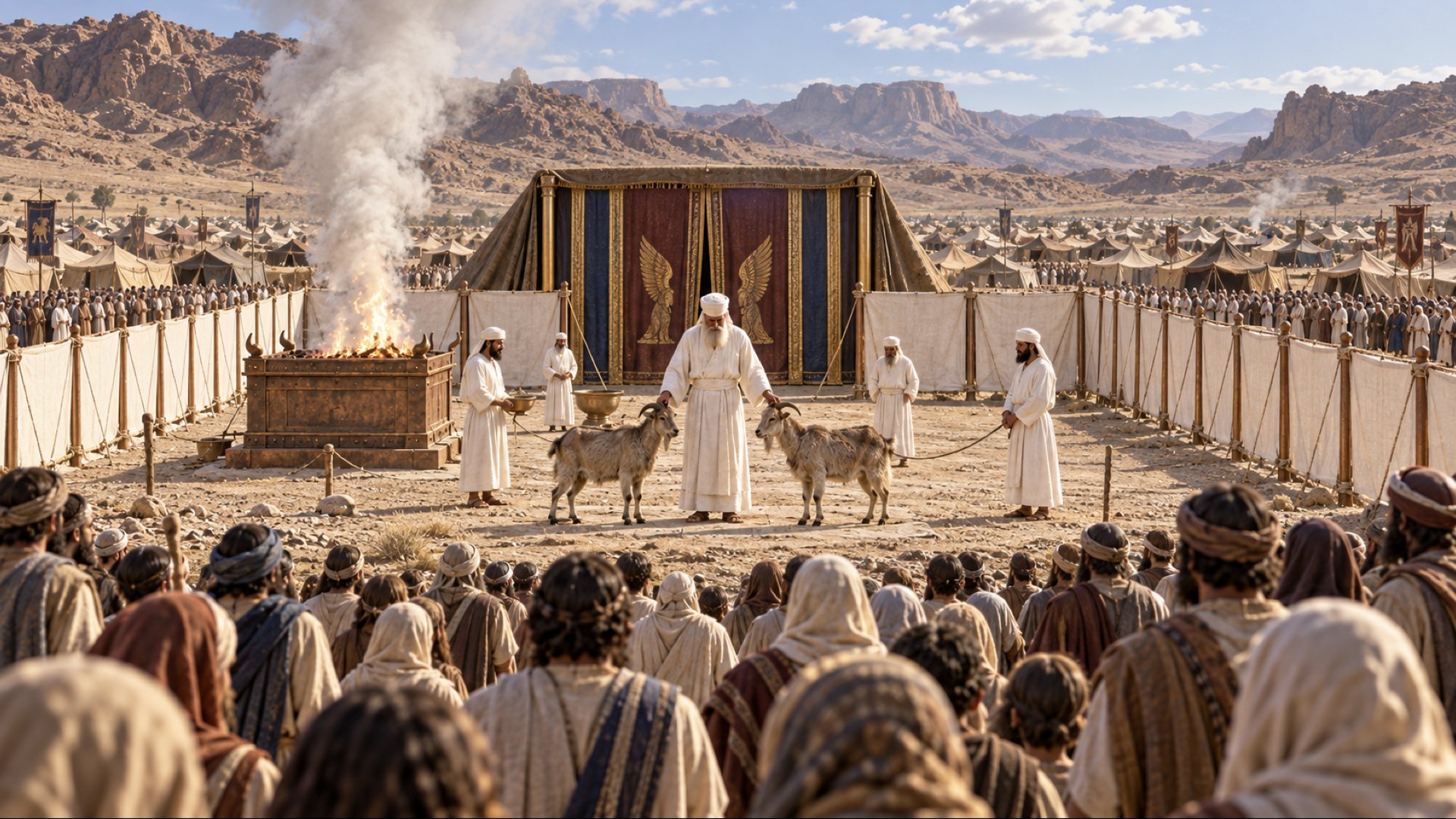
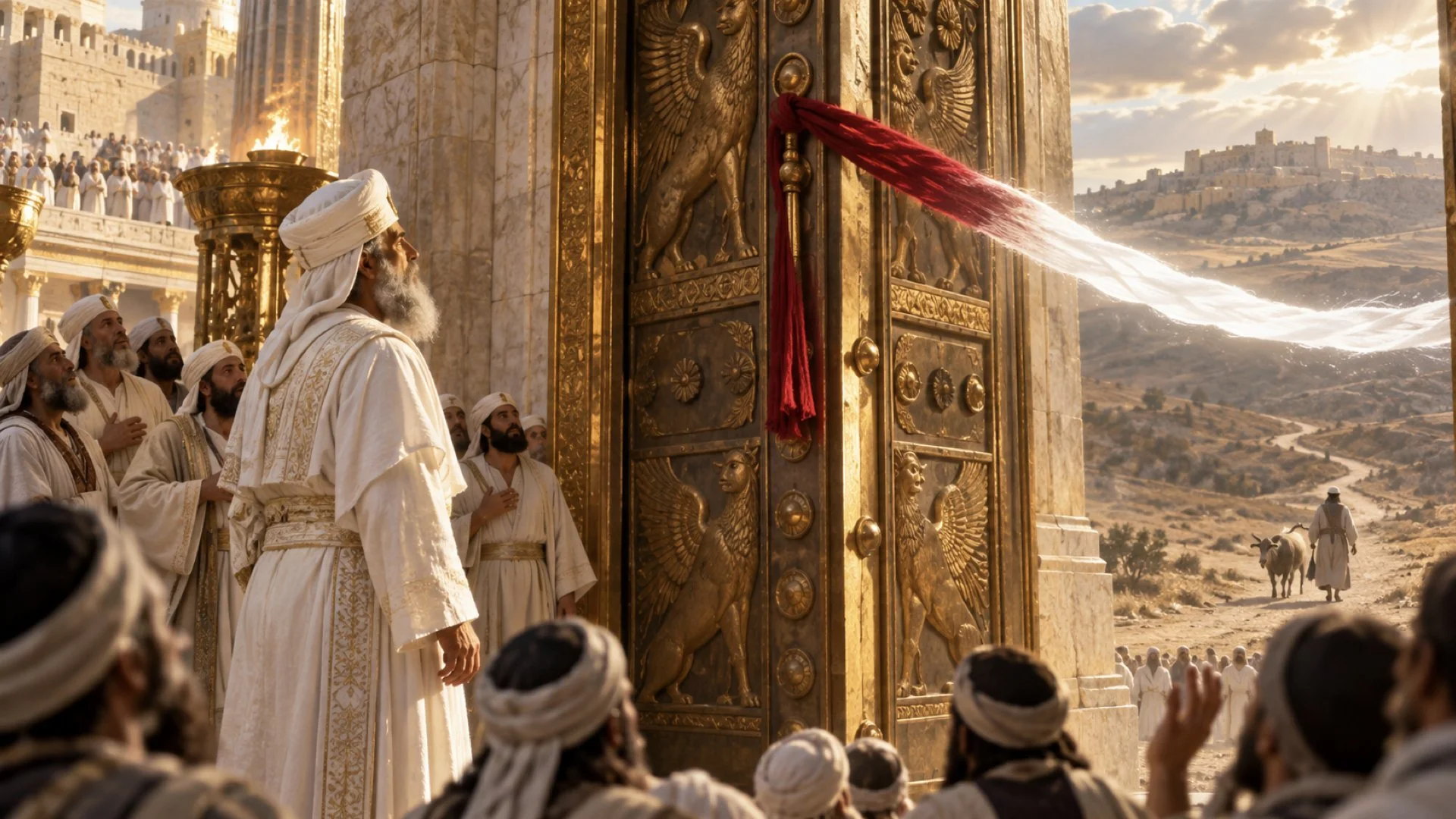
The laying on of hands, associated with the Hebrew term semikhah, represented identification and the symbolic transfer of sin. The two goats together reveal two aspects of Christ's work: the offering of life to deal with sin and its consequences, and the removal of sin from the people.
Second Corinthians 5:21 explains that God made Jesus, who knew no sin, to be sin for us so that we might become the righteousness of God in Him.
David captures the heart of this promise in Psalm 103:10–12, declaring that God has not dealt with us according to our sins or rewarded us according to our iniquities. As far as the east is from the west, so far has He removed our transgressions from us.
What Yom Kippur represented temporarily, Jesus has accomplished eternally.
2. The Blood of Christ: Cleansed and Made Holy Forever
Hebrews explains how Jesus accomplished something infinitely greater than the old covenant sacrifices. Under the law, priests continually offered sacrifices, and the high priest entered the Most Holy Place annually with the blood of animals. These sacrifices served their appointed purpose, but they could never produce eternal redemption or permanently remove sin.
Hebrews 9:11–14 tells us that Christ entered the greater and more perfect tabernacle, not made with human hands, and entered the Most Holy Place once for all by His own blood, having obtained eternal redemption. The blood of animals provided ceremonial cleansing, but the blood of Christ cleanses our consciences from dead works so that we may serve the living God.
Jesus did not merely obtain another temporary covering for sin. His sacrifice secured eternal redemption.
Hebrews 9:24–26 explains that Christ entered heaven itself to appear in God's presence for us. He did not enter to offer Himself repeatedly. He appeared once for all to put away sin through the sacrifice of Himself.
Because He did, we can stand before the Father without guilt. Our conscience can be cleansed because Jesus has dealt with our guilt and given us His righteousness. Romans 5:8–10 reminds us that while we were still sinners, Christ died for us. Having been justified by His blood, we are saved from wrath through Him.
Hebrews 10:14 declares:
"For by one offering he hath perfected for ever them that are sanctified." (KJV)
Sanctification is not something we accomplish through increasingly successful religious performance. We are sanctified through the offering of Jesus Christ. His blood cleanses us and establishes us in a holy state before God. From that holiness, we learn to live in ways that reflect what He has accomplished within us.
We certainly grow in maturity, understanding, and obedience, but we do not progressively earn the spiritual holiness Jesus has already given us.
A cup in the old covenant tabernacle was not holy because it behaved properly. It became holy because it was cleansed and consecrated according to God's instructions. The same principle helps us understand our sanctification. We are made holy through Christ, and then we live from that holiness.
Obedience is the fruit of righteousness, not the means by which we become righteous.
This also changes how we understand repentance. Jesus is not continually offering Himself for every new sin. His sacrifice was offered once, and its effectiveness is eternal. Repentance is a change of mind that brings our thinking and behavior back into agreement with what Christ has accomplished.
Consider the woman caught in adultery in John 8. Jesus removed her condemnation and then instructed her to go and sin no more. Notice the order. Freedom came before responsibility. Grace made a new life possible.
3. The Removal of the Old Sinful Nature: From Death to Life
The second goat on the Day of Atonement provides a profound picture of the removal of sin. The high priest confessed Israel's sins over the living goat, and it carried them away into the wilderness. Under the new covenant, this points toward something even greater than the removal of guilt. It points toward the inward transformation that occurs when someone is born again.
When we receive Christ, God does not simply forgive us and leave us spiritually unchanged. Our old man is crucified with Christ. Our old sinful nature is removed, our spirit is brought from death to life, and we receive a new heart capable of fellowship with God.
Colossians 2 explains that all the fullness of the Godhead dwells bodily in Christ and that we have been made complete in Him, who is the head of all principality and power.
Then Paul describes a circumcision performed without human hands:
"In whom also ye are circumcised with the circumcision made without hands, in putting off the body of the sins of the flesh by the circumcision of Christ." (Colossians 2:11, KJV)
This spiritual circumcision is performed by Christ Himself. The phrase "body of the sins of the flesh" includes the Greek terms sōma, meaning body, and sarx, meaning flesh. Here, we are considering the removal of the old sinful condition that characterized us apart from Christ.
Paul continues by explaining that we were buried with Christ in baptism and raised with Him through faith in the working of God. When we were dead in our trespasses, God made us alive together with Christ, having forgiven all our trespasses.
This is the new birth.
Romans 6 describes our old man being crucified with Christ so that we should no longer be slaves to sin. This is why I teach that the born-again believer does not have two spiritual natures competing for ownership of the same person. God has made you new in Christ.
Believers can still sin. We have bodies with natural desires, minds that need renewing, and learned patterns of behavior. But our failures do not mean the old sinful nature remains our spiritual identity.
Ephesians 4:22–24 instructs us to renew our minds and put on the new man, which was created according to God in righteousness and true holiness. Notice that the new man has already been created in righteousness and holiness.
We renew our minds to express what God has already accomplished within us. When facing temptation, the answer is not to persuade ourselves that we remain spiritually corrupt. The answer is to remember who we have become in Christ and allow His grace to strengthen us to live accordingly.
4. Cleansed for His Presence: You Are Now the Temple of God
One of the remarkable dimensions of the Day of Atonement was the extensive cleansing required for the tabernacle and its furnishings. The sanctuary was the appointed dwelling place of God's presence among Israel.
Under the new covenant, God dwells within those who have been born again.
First Corinthians 6:19 reminds us that our bodies are the temple of the Holy Spirit who is in us. Everything the high priest did to prepare the sanctuary for God's presence was pointing toward something God would eventually accomplish within us.
We can draw several meaningful parallels between the tabernacle and the work of Christ. The bronze altar reminds us that our old man was crucified with Christ. The bronze laver points toward our washing and regeneration. The golden lampstand illustrates our spirit being brought from darkness into life. The table of showbread reminds us that Christ is our life and spiritual sustenance.
The altar of incense pictures the new heart God has given us, capable of fellowship with Him. The Ark of the Covenant points toward the indwelling presence of God. The sanctuary as a whole illustrates the believer being set apart as God's dwelling place, while the holy vessels remind us that we have been cleansed and consecrated for His purposes.
These are illustrations rather than exact one-to-one interpretations, but they reveal the many dimensions of our redemption.
Ezekiel 36:26–27 contains the remarkable promise that God would give us a new heart, place a new spirit within us, remove the heart of stone, and put His own Spirit within us.
Through the new birth, the believer becomes the dwelling place of the Holy Spirit. As we yield to Him and are filled with the Spirit, His power, wisdom, and gifts can be expressed through our lives for the glory of Christ.
The Christian life is not simply an attempt to imitate Jesus through willpower. It is the life of Christ being expressed through someone transformed inwardly and joined to Him by the Spirit.
This should change how we think about ministry. We are not simply accumulating Bible knowledge for ourselves. We are being equipped to carry Jesus into the world.
Do not allow imperfect performance to convince you that you are disqualified from being a light to someone else. The Spirit of God lives within you, and you have more to offer than you may realize.
You are a living temple, carrying the presence of God wherever you go.
5. Jesus Is Supreme: His Victory Over Darkness Is Our Foundation
All of this establishes the foundation for our October series: Jesus has conquered death, secured our redemption, and disarmed the powers of darkness.
Before studying demonic activity, spiritual deception, witchcraft, or occult practices, we must establish the supremacy of Christ. Otherwise, we can easily approach these subjects from fear or an exaggerated view of the enemy's power.
Colossians 2 brings together the inward transformation of the believer and Christ's victory over spiritual authorities. Paul explains that we have been made complete in Christ, describes the removal of our old sinful condition, and declares that Jesus canceled the record of debt against us, nailing it to His cross.
Then he writes:
"And having spoiled principalities and powers, he made a shew of them openly, triumphing over them in it." (Colossians 2:15, KJV)
The same cross that secured our forgiveness and removed our old sinful nature was also the means by which Jesus triumphed over the powers of darkness.
Jesus declared in Matthew 28:18 that all authority had been given to Him in heaven and on earth. Revelation 1:18 presents Him as the one who was dead and is alive forevermore, holding the keys of death and Hades.
He has authority over heaven, earth, death, and the grave.
This does not mean evil no longer operates in the world. Scripture warns about spiritual wickedness, deception, and the strategies of the devil. But these powers are not equal competitors with Jesus. They are defeated powers operating in a world where Christ's victory has already been established.
Our responsibility is not to become fascinated with darkness or frightened by evil. It is to become fully persuaded of who Jesus is, what He accomplished, and who we have become in Him.
As we examine witchcraft, New Age teachings, spiritual manipulation, and attempts to control outcomes apart from God, we must remember that our completeness is already found in Christ. Even prayer can become distorted when used to force an outcome rather than commune with God and trust His wisdom.
Our authority comes from Him. Our righteousness comes from Him. Our holiness comes from Him. Our freedom from condemnation comes from Him.
And the ultimate evidence of spiritual maturity is love. The purpose of redemption is not simply to make us powerful. It is to restore us to the Father and allow His love and life to be expressed through us.
We are not studying darkness to discover whether Jesus has enough power to overcome it. We are studying these things because Jesus has already triumphed, and we need to understand how to stand in the authority and freedom He has given us.
Bible Study Homework and Practical Application
I encourage you to study these truths for yourself and allow the Holy Spirit to illuminate what Jesus has accomplished.
Your primary homework is to read Leviticus 16 and the entire book of Hebrews. Leviticus 16 describes the Day of Atonement, while Hebrews explains how Jesus fulfilled and surpassed the old covenant sacrificial system through His once-for-all sacrifice.
Before reading Hebrews, I recommend watching the two overview videos from BibleProject, which provide helpful context. You can read or listen to Hebrews in one sitting, then revisit it over the next couple of weeks.
For a deeper understanding, I also encourage you to work through my Book of Hebrews Course at Forward School of Transformation. This course will help you understand the superiority of Jesus, the new covenant, His priesthood, and the eternal redemption secured through His finished work.
As you study, meditate on Hebrews 9:26, which declares that Jesus appeared once for all to put away sin through the sacrifice of Himself. Ask the Holy Spirit to reveal what that means for your identity, your conscience, and your relationship with God.
For a practical exercise, consider an area where you struggle with temptation, guilt, or fear. Rather than beginning with your failure, begin with what Jesus has accomplished. Ask yourself: Who am I now in Christ? Has Jesus already dealt with this? Am I responding as someone still trapped in sin or as someone Christ has made free?
Finally, take time to acknowledge the Holy Spirit within you. Make these truths personal:
I am redeemed through the blood of Christ. I am forgiven, righteous, sanctified, and holy through Jesus. My old sinful nature has been removed. I have a new heart and have been made alive in Christ. The Holy Spirit dwells within me. I am complete in Christ, and He is supreme over every principality and power.
The Day of Atonement was the shadow. Jesus is the substance. The old covenant anticipated a greater cleansing, a better sacrifice, and eternal redemption. Through His death, burial, and resurrection, Jesus accomplished it all.
You have been cleansed for His presence, made holy through His blood, and brought into eternal union with Him. Now live from the freedom, righteousness, and authority He has given you.