
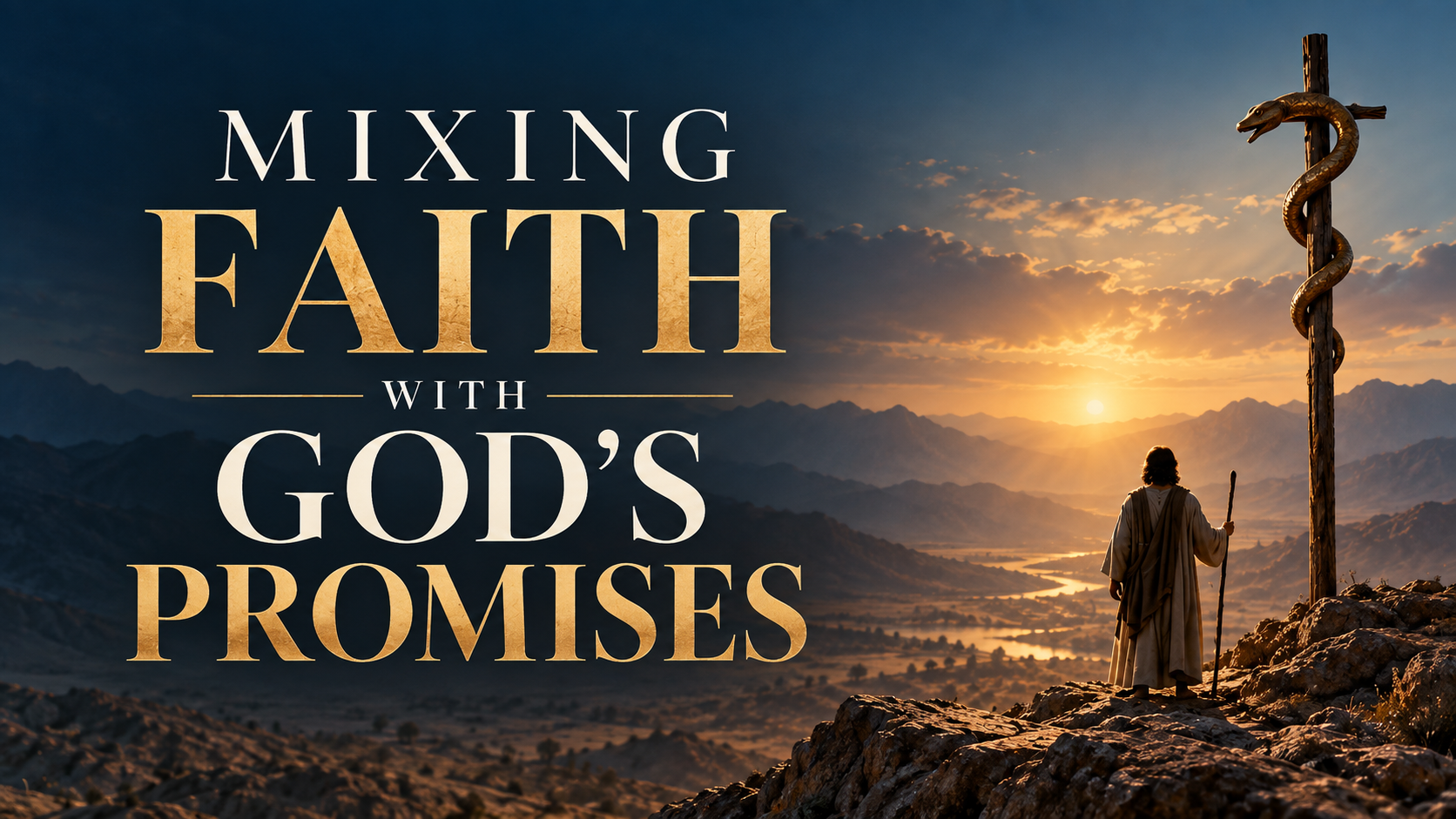
Mixing Faith with God's Spoken Promise
What you focus on shapes what you see, and when you continually complain about what’s wrong, you can become blind to God’s provision and even begin to loathe the manna at your feet. Instead of letting the snakes of life consume your attention, mix God’s promises with faith, keep your eyes on Jesus, sow gratitude, and let love—not spiritual elitism—be the true measure of your maturity.
The children of Israel wandered through the wilderness surrounded by the supernatural provision of God. He had delivered them from slavery in Egypt, led them by cloud and fire, provided water in the desert, and fed them every single morning.
Then in Numbers 21:5 they said:
“Our soul loatheth this light bread.”
They were talking about manna.
Every morning they woke up, walked outside their tents, and the food was already there. God was daily providing for them in the wilderness, and somehow they had become bored with the miracle.
That is the danger of familiarity.
The manna was pointing to Jesus, the Bread of Life. Israel received bread that sustained their bodies daily, but Christ sustains us eternally. And just as they began to take the manna for granted, we can begin to take Jesus for granted.
Think about what God has done for us. The most powerful Being who exists loves you. He moved heaven and earth to save you. Christ became flesh, died for you, became your sin and the curse, rose again, delivered you from the power of darkness, cleansed you, gave you a new heart, joined His Spirit to you, and gave you eternal life.
And somehow we can still say, in effect, I’m bored.
I need a revival. I need another word. I need another revelation. I need somebody more anointed. I need something to make me feel spiritually alive again.
Meanwhile, Jesus is still the Bread of Life, daily providing for us.
Mixing Faith with the Word
Sometimes we do not need something new. We need to become amazed again by what we already have.
Hebrews 3 looks back at Israel’s wilderness experience and says that they hardened their hearts and could not enter in because of unbelief. Hebrews 4:2 explains why:
“The word preached did not profit them, not being mixed with faith in them that heard it.”
God had spoken to them. He told them He would bring them into the land, drive out their enemies, establish them there, and make them a blessing.
They had the word.
They simply did not mix it with faith.
Instead, they mixed their circumstances with complaining.
The longer they rehearsed what was wrong, the more what was wrong became all they could see. Complaint does not merely describe your experience. Over time, it trains your attention.
What you repeatedly focus on trains what you notice.
If you continually rehearse lack, frustration, disappointment, offense, and everything other people are doing wrong, you can eventually be surrounded by God’s provision while believing He is not providing.
Israel was eating supernatural bread while saying, “There is no bread.” That is how distorted complaint can make our perspective.
We have to stop interpreting God’s will through the lack in our lives. God’s character must interpret our circumstances. Our circumstances do not get to redefine God’s character. He is good. He is a good Father. His heart toward us has been revealed in Christ, and the cross has already settled that question.
When fiery serpents came among Israel, God told Moses to lift up a bronze serpent. Anyone who looked at it lived.
Jesus later said in John 3:14–15:
“And as Moses lifted up the serpent in the wilderness, even so must the Son of man be lifted up: that whosoever believeth in him should not perish, but have eternal life.”
The serpent was a shadow. Jesus is the fulfillment. They looked and lived.
We look to Christ and receive life.
And in John 12:31–33, Jesus again spoke of being lifted up in the context of judgment and His coming death. The cross is where sin, judgment, the curse, and death came upon Christ.
So when circumstances get loud, look at Jesus. When disappointment starts hardening your heart, look at Jesus. When you feel like God has forgotten you, look again.
Stay with the finished work of Christ long enough for it to stir you again.
Hebrews 4 says that “we which have believed do enter into rest,” and that “there remaineth therefore a rest to the people of God.”
This changes the posture of the Christian life.
Many of us came from versions of Christianity that kept us feeling like something was always missing. We needed the next revival, the next conference, the next anointed teacher, the next revelation, the next breakthrough, or another level of holiness.
Our pursuit of God was often driven by lack.
But Christ satisfies.
That does not mean we stop pursuing Him. It means we pursue Him from a different place. We are not pursuing Him to become complete. We pursue Him because we are complete in Him. We are not worshiping to get Him to come near. We worship because He has already joined Himself to us.
We are not looking for the missing ingredient that will finally make Christianity work. We are learning to live from what Christ has already finished.
There can still be hunger, but it is not the hunger of emptiness. It is the hunger of gratitude.
You can be satisfied and still want to know Him more. You can be full and still have an appetite.
And sometimes what we call spiritual hunger may not mean we need God to put something else into us. Sometimes it means it is time to pour out what He has already placed within us.
Love somebody. Encourage somebody. Pray for somebody. Serve. Give. Teach. Share Christ. Use your gifts.
Maybe you are not empty. Maybe you are full.
Jesus is not merely the beginning of Christianity before we move on to something deeper.
He is the depth.
He is the Bread of Life, daily sustaining us. He is our righteousness, our peace, our life, and our union with God.
So keep pursuing Him. Keep growing. Keep believing. Keep mixing faith with what He has spoken.
But do it from rest.
Do it from fullness.
Do it from gratitude rather than complaint.
Don’t get bored with the Bread of Life. Look again at Jesus, remember how good He is, and let Christ satisfy your soul.
What area of life do you find yourself complaining about where Jesus has already provided a promise for you to stand on? And how will you renew your mind to not become bored with his daily life?
Are You Ready?
What if the biggest thing standing between you and God's purpose isn't a lack of faith, but a life filled with distractions? Discover how renewing your mind with God's wisdom prepares you to recognize the divine opportunities He places in front of you every day—and to respond with confidence instead of hesitation.
What if the biggest thing standing between you and God's purpose isn't a lack of faith, but a life filled with distractions?
God has divine appointments for you.
There are people you will meet, conversations you will have, and moments when something rises in your heart and you realize, I need to say something. I need to encourage this person. I need to pray for them. I need to help.
The question is: Will you be ready when the moment comes?
Being ready isn't necessarily about becoming better at hearing God speak in perfectly formed sentences. I don't spend my life trying to get God to give me a detailed set of instructions for every decision I make. I would rather live in a place of inward peace—full of faith, hope, expectation, and love—and trust that as I walk with Him, He is leading me.
When you're inwardly free from distraction, you can become sensitive to what God is doing around you.
You might feel prompted to go somewhere, call someone, encourage your spouse, speak to a server, pray for someone, give something away, or simply say the thing that's already in your heart.
Those moments may seem small, but you don't know what God can do through one moment of obedience.
What's Distracting You?
Hebrews 12 tells us:
“Wherefore seeing we also are compassed about with so great a cloud of witnesses, let us lay aside every weight, and the sin which doth so easily beset us, and let us run with patience the race that is set before us,
Looking unto Jesus the author and finisher of our faith...”
—Hebrews 12:1–2 KJV
Notice that Scripture distinguishes between weights and sin.
Not everything distracting you is necessarily sinful. Some things are simply weighing you down.
It might be your finances. Your health. Something happening at home. A relationship. An unresolved emotional issue. Fear. Shame. Exhaustion. Or it may be a sin that continues to entangle you.
Whatever it is, ask yourself:
What is taking me out of the game?
What is consuming so much of my emotional energy that I'm not present anymore? What keeps me so preoccupied with myself that I don't notice the person God has put right in front of me?
Identify it.
Then ask the harder question:
What am I going to do about it?
Don't Just Hear the Truth—Make a Plan
I don't want us to simply hear good sermons. I don't want us to know a lot of truth and never actually change.
If something continually keeps you stuck, develop a plan.
If you need counseling, get counseling. If your finances are constantly creating chaos, learn how to manage your finances. If you're trapped in destructive patterns of thinking, renew your mind. If you're struggling with a particular sin, get Scripture specifically related to that area and begin seeing yourself through the finished work of Christ.
Talk to somebody you trust. Pray with somebody. Read something. Get help.
Do something. Take a step.
You may have tried 97 times already. Try again—but this time don't approach the problem from condemnation. Approach it from your identity in Christ.
You aren't trying to change so God will accept you.
You are changing because He already has.
You Are God's Workmanship
Ephesians 2:8–10 says:
“For by grace are ye saved through faith; and that not of yourselves: it is the gift of God:
Not of works, lest any man should boast.
For we are his workmanship, created in Christ Jesus unto good works, which God hath before ordained that we should walk in them.”
—Ephesians 2:8–10 KJV
You are God's workmanship.
Your righteousness isn't the product of your perfect behavior. God did something in you through Christ. You have been recreated in Him.
But notice what follows salvation by grace: good works.
We aren't saved by good works. We are recreated for good works.
Grace shouldn't make us passive. Knowing that we are completely free from condemnation should make us some of the most productive, courageous, loving people on the planet.
God has made doing good our way of life.
You Don't Have to Be Paralyzed by Every Decision
Sometimes Christians become so concerned about finding God's exact will that they become afraid to do anything.
Is this God's will?
Am I hearing Him correctly?
What if I make the wrong decision?
There are certainly moments when God leads us toward something very specific. But you don't have to live terrified that one wrong turn will take you outside His ability to lead you.
God is incredibly creative.
You may do something differently than I would do it. Someone else may approach the same opportunity another way. Yet God can work through all of us.
You get to be you.
The bigger question is: What condition is your heart in while you're making the decision?
Are you walking in peace?
Are you full of hope?
Are you expecting God's goodness?
Are you motivated by love?
Do you have a clear conscience before Him?
If so, make a decision and move forward.
A Clear Conscience Is Invaluable
Peter writes:
“But sanctify the Lord God in your hearts: and be ready always to give an answer to every man that asketh you a reason of the hope that is in you with meekness and fear:
Having a good conscience...”
—1 Peter 3:15–16 KJV
There it is again:
Be ready.
A clear conscience before God is invaluable because shame makes us pull away from Him.
Sin does not undo what Christ accomplished or suddenly detach a believer from Christ, but sin can affect our confidence. Shame can make us withdraw emotionally. We hide internally just like Adam hid among the trees.
That's one reason we don't want sin dominating our lives.
Not because we're desperately trying to keep God happy with us.
Christ already dealt with condemnation at the cross.
We want freedom because we have a God to represent.
We want enough inward peace that when God gives us an opportunity to love somebody, encourage somebody, forgive somebody, pray for somebody, or share the gospel, we're available.
Look at Jesus
So how do we change?
Hebrews gives us the answer:
“Looking unto Jesus.”
And then:
“Consider him...”
Again and again, transformation comes back to seeing Him.
The areas where we're still struggling are often the areas where we don't yet see God clearly. As we see Him rightly, we are transformed into His image.
That's why the death, burial, and resurrection of Jesus are so central.
Look at the cross and see what God thinks about you.
Look at Jesus and see God's character.
See His mercy.
See His righteousness.
See His forgiveness.
See His love.
See what He has made you through His finished work.
Then begin seeing yourself accordingly.
You don't overcome sin by obsessing over sin. You overcome by renewing your mind, putting on the new man, and learning to see yourself through what Christ has accomplished.
Grace teaches us to live godly lives.
The World Needs to See What God Is Like
There is a world around us that does not know how good God is.
Many people have been taught that every tragedy, disease, injustice, and loss somehow represents God's mysterious plan for their lives.
Then Jesus comes along and shows us what God is actually like.
He goes about doing good.
He forgives.
He heals.
He shows mercy.
He restores.
He delivers people from bondage.
He sets people free from condemnation.
And ultimately, He gives Himself for us.
Now we're His representatives.
Sometimes one of the most powerful things you can possibly do is simply become an agent of forgiveness. Someone hurts you, and instead of returning their offense, you become part of their healing.
That's Jesus.
Imagine a world filled with believers who were inwardly free enough to live that way.
Not perfect people.
Not people pretending they don't have problems.
People who know where to take their problems.
People who know who they are in Christ.
People with clear consciences, peaceful hearts, renewed minds, and enough confidence in God's love that they aren't constantly consumed with themselves.
Those people are ready.
So, Are You Ready?
What distraction do you need to minimize?
What sin continues to entangle you?
What unresolved issue keeps consuming your attention?
Identify it.
And then make a plan.
Get some Scriptures. Put them in the first person. Renew your mind. Talk to somebody. Get counseling if you need it. Ask for prayer. Make changes. Take responsibility for the things you actually can change.
But don't do any of it believing God is standing over you waiting to reject you.
He's with you.
He's for you.
He's going to encourage you, strengthen you, correct you, teach you, and walk with you.
You have the rest of your life in front of you.
Don't let it be consumed entirely by your job, your problems, your bills, your mistakes, or your distractions.
You have a God to represent.
There are people who need to know what He is actually like. There are divine appointments waiting in ordinary moments. There are people who need the hope, forgiveness, peace, and love that Christ has placed within you.
Eliminate the distractions.
Renew your mind.
Fix your eyes on Jesus.
And when the opportunity comes—
be ready.
I can also make a shorter, sharper web version of this—around 800–1,000 words—with an article highlights section at the top, similar to the format we've used for your other sermon blogs.
the snakes of life come for you when you complain
When you live focused on what’s wrong—complaining, rehearsing what you lack, and overlooking the grace already in your life—the snakes of life will eventually come for you as you begin to reap the fruit of that perspective. But just as Israel looked at the bronze serpent and lived (Numbers 21:8–9), Jesus tells us to look to Him and believe (John 3:14–17), allowing the cross to turn our eyes from what’s wrong to the One who has already provided our salvation, healing, and transformation.
There is a strange story in Numbers 21 that Jesus chose as one of the clearest pictures of salvation when he gave one of His most profound statements. When Jesus revealed to Nicodemus that we must be born again in John 3, He used the story of the brass serpent to create the image of Himself being lifted up to become the curse of the Law and experience judgment for all of humanity.
Israel had lived for nearly forty years under supernatural provision. God fed them with manna every day. He gave them water in the wilderness. Their clothes did not wear out. A cloud led them by day and a pillar of fire by night. God had delivered them from slavery and sustained them through an environment where they should not have been able to survive.
And eventually, they got bored with it.
Numbers 21:4 says, “the soul of the people was much discouraged because of the way.” Then something important happened:
“And the people spake against God, and against Moses, Wherefore have ye brought us up out of Egypt to die in the wilderness? for there is no bread, neither is there any water; and our soul loatheth this light bread.”
—Numbers 21:5
Notice how distorted their perspective had become.
They said there was no food while they were eating food God miraculously provided every day. They complained about having no water after God had repeatedly sustained them with water in the wilderness. They looked at supernatural provision and called it worthless.
They stopped seeing what God had done and became consumed with what they thought was missing.
Then the snakes came.
“And the LORD sent fiery serpents among the people, and they bit the people; and much people of Israel died.”
—Numbers 21:6

We are not under that covenant today. God is not sending sickness, financial trouble, marriage problems, flat tires, difficult children, or other forms of suffering to punish Christians for complaining. Jesus already bore our judgment at the cross. It would be illegal if God judged you for your sin, since Jesus was already judged and punished for them.
But there is still a principle here we shouldn't miss:
When complaining becomes your perspective, the snakes of life will eventually come for you.
Galatians tells us that God is not mocked: whatever a person sows, that is what he will reap. We still live in a world of seed and harvest.
A consistently negative perspective produces something.
Complaining changes how you see your spouse. It changes how you interpret your circumstances. It changes what you notice about your job, your church, your children, your future, and eventually even God.
Fear does the same thing.
Some people excuse negativity because they're afraid. But whether it comes from fear, disappointment, bitterness, or frustration, if you continually train yourself to look for what's wrong, you will become incredibly good at finding it.
Eventually, what is happening inside of you begins producing something outside of you.
The snakes of life come in different forms.
Maybe the snake is bitterness. Maybe it's a marriage slowly deteriorating because every disagreement becomes an opportunity to blame the other person. Maybe it's insecurity that causes you to manipulate people. Maybe it's fear that keeps producing bad decisions.
Maybe it's resentment, lust, anger, isolation, cynicism, or a constant dissatisfaction that makes it impossible to enjoy what God has already put in your life. Sometimes we're asking God to remove a snake that our own attitudes and decisions keep feeding.
That's why gratitude is so powerful.
Gratitude trains your eyes to recognize grace. Complaining trains your eyes to recognize lack.
Israel had manna on the ground, water available, freedom from Egypt, and the presence of God in their midst—and still concluded that they had nothing.
That's what complaining can do to the soul.
Look and Live
When Israel finally recognized what was happening, they came to Moses and said, “We have sinned, for we have spoken against the LORD, and against thee.” They asked Moses to pray that the serpents would be taken away (Numbers 21:7).
God's answer is fascinating.
“And the LORD said unto Moses, Make thee a fiery serpent, and set it upon a pole: and it shall come to pass, that every one that is bitten, when he looketh upon it, shall live.”
—Numbers 21:8
Moses made the bronze serpent, lifted it up, and Numbers 21:9 says that when someone who had been bitten “beheld the serpent of brass, he lived.”
They looked and lived.
God did not tell the bitten person to prove that he had changed. He didn't require him to keep the Law perfectly for seven days before healing him. He didn't tell him to make up for every complaint he had made.
He gave him something to look at.
Thousands of years later, Jesus is having a conversation with Nicodemus, a teacher of Israel who understood Torah, Law, sacrifice, priesthood, and righteousness.
And Jesus takes Nicodemus directly back to this story:
“And as Moses lifted up the serpent in the wilderness, even so must the Son of man be lifted up: That whosoever believeth in him should not perish, but have eternal life.”
—John 3:14–15
Then Jesus makes the statement that has become the most famous verse in Scripture:
“For God so loved the world, that he gave his only begotten Son, that whosoever believeth in him should not perish, but have everlasting life.”
—John 3:16
And He continues:
“For God sent not his Son into the world to condemn the world; but that the world through him might be saved.”
—John 3:17
Jesus preached faith righteousness.
Look and live.
Believe and receive.
What Are You Looking At?
Later Jesus returned to the imagery of being lifted up:
“Now is the judgment of this world: now shall the prince of this world be cast out. And I, if I be lifted up from the earth, will draw all men unto me.”
—John 12:31–32
The cross becomes the place where we look.
Christ became the curse for us. He bore our sin. He entered into death. He took upon Himself what separated humanity from God and defeated it through His death and resurrection.
So when the snakes of life come for you, the answer isn't to spend the rest of your life staring at the snakes.
Look at Christ.
This is where Christianity has to become more than information.
Hebrews says:
“For the word of God is quick, and powerful, and sharper than any twoedged sword… and is a discerner of the thoughts and intents of the heart.”
—Hebrews 4:12
Don't just read the Word. Let the Word read you.
Ask yourself what your reactions are revealing.
Why am I so angry?
Why am I constantly offended?
Why am I afraid?
Why do I need everyone to approve of me?
Why do I keep manipulating situations?
Why do I keep sabotaging relationships?
Why can I walk into a room with a hundred things going right and immediately notice the one thing that's wrong?
Those are snakes worth identifying.
But once you identify them, don't make the snake your meditation.
Look to Jesus.
The areas where you're still struggling are often the areas where you need to see Him more clearly.
If you're insecure, look at the cross until you see your value.
If you're bitter, look at Jesus until you understand how completely you've been forgiven.
If you're afraid, look at Him until His faithfulness becomes more real than what you're afraid of.
If you're hurting people because you're hurting, look at how Christ has loved you until His love begins healing the place inside you that keeps producing destruction.
This isn't merely behavior modification.
It's transformation through beholding.
Don't Call the Manna Worthless
One of the saddest parts of Numbers 21 is that the Israelites were surrounded by miracles and couldn't see them anymore.
The manna had become ordinary.
The provision had become expected.
The presence of God had become familiar.
And familiarity turned into ingratitude.
We can do the same thing with the gospel.
We can become so accustomed to hearing that we're forgiven, righteous in Christ, reconciled to God, filled with His Spirit, and destined for eternal life that we start looking for something more exciting.
Don't call the manna worthless.
Don't let the gospel become boring.
Daily grace is miraculous. Daily communion with God is miraculous. Having the Spirit of God dwelling within you is miraculous. Knowing that your name is written in heaven is miraculous.
Learn to enjoy today's bread.
Learn to recognize God's goodness again.
Learn to be grateful for what is already in your life instead of continually rehearsing what isn't.
Because complaining has a cost.
If you spend your life looking for what's wrong, eventually the snakes of life will come for you.
But when they do, don't stare at the snakes.
Don't stare at your failure.
Don't stare at your circumstances.
Don't stare at everything that's wrong.
Lift your eyes.
Look at the One who became the curse for you.
Look at the One who bore your sin.
Look at the One who loved you enough to enter into death and bring you out of it.
See your value in Him. See your righteousness in Him. See His kindness, patience, purity, faithfulness, strength, and love.
And let what you see in Him change what is happening in you.
Gratitude keeps your eyes on grace. Complaining keeps your eyes on lack.
So when the snakes of life come for you, remember the simplicity of the gospel:
Look to Jesus and live.
Discussion Questions
Where have you seen complaining or consistently focusing on what’s wrong become a “snake of life” that produces consequences in your attitude, decisions, or relationships?
What does it practically look like to “look to Jesus” in an area where you’re currently struggling rather than continually looking at the problem?
Israel became so familiar with God’s daily provision that they called the manna worthless. What has God already provided in your life that you may need to recognize again with fresh gratitude?
Granddaddy's favorite
Attending Pete's funeral reminded me that the Church is at its best when it feels like family, where people are deeply known and genuinely loved. When we love one another the way Christ has loved us, we give the world a reason to say, "I want to be part of that family."
I attended a funeral recently that reminded me what the Church is supposed to look like.
It was the celebration of life for Pete Cavendar. What made the service so memorable wasn't a polished eulogy. Instead, one by one, his grandchildren stood up and shared stories. Some had prepared a few thoughts, others spoke off the cuff, but as I listened something became obvious. Every one of them thought they were Granddaddy's favorite.
As I listened to his family members lovingly remember him, I caught myself thinking. I wish he were my grandaddy too so I could be part of that family. That this is exactly what Jesus intended His Church to be, a family that loves well and compels others to want Jesus because of how we love one another.
Showing the World God’s Love
"Beloved, let us love one another: for love is of God... Beloved, if God so loved us, we ought also to love one another. No man hath seen God at any time. If we love one another, God dwelleth in us, and his love is perfected in us." (1 John 4:7, 11-12)
Think about that. No one has seen God, but people can see His character through His children.
That's what I witnessed at Pete's funeral.
Those grandchildren weren't talking about theology. They weren't explaining doctrine. They were simply describing a man who consistently loved them, and through that love they caught a glimpse of the Father's heart.
Jesus prayed something remarkable in John 17. He asked the Father that His followers would become one, "that the world may believe that You sent Me." We often think miracles are what convince people Jesus is real, and certainly God still heals and works powerfully today. But Jesus Himself pointed to something even greater.
Our love for one another.
The world should be able to look at the Church and say, I want to be part of that family.
Honestly, that's exactly what I found myself thinking during that service. Watching those grandchildren laugh, cry, tell stories, and honor their Granddaddy made me think, This is what people are looking for.
People are hungry for family.
They're looking for a place where they're known, valued, and loved. They want someone who notices them, believes in them, and makes them feel like they matter.
The Church should be that place.
Not because we've built better programs, but because we've learned to love each other the way Christ has loved us.
John continues,
"There is no fear in love; but perfect love casteth out fear... We love him, because he first loved us." (1 John 4:18-19)
Everything begins there. We don't manufacture love. We receive it. We allow ourselves to be convinced that God truly loves us, and then that love begins to overflow into the lives of others.
Forgiveness
Sometimes the greatest act of love is simply forgiving those who have wounded us. The cross made that possible. Jesus bore our sin so we could release the sins committed against us. As His love matures in our hearts, we're no longer defined by our wounds. We're free to love people—even imperfect people—the way we've been loved.
When that happens, the Church becomes something the world can't ignore.
Imagine a church where every person who walks through the doors leaves feeling like Pete's grandchildren did—that somehow they were seen, known, and deeply loved.
Imagine neighborhoods where believers consistently serve one another without needing recognition.
Imagine businesses run with integrity, families marked by forgiveness, and friendships defined by faithfulness.
That's the witness Jesus envisioned.
My prayer after attending that funeral is simple: may the people around us experience the love of God so clearly through our lives that they don't just believe the gospel is true—they want to become part of the family that lives it.
Change Your Thoughts, Change Your Life
The cross is the lens everything else should be filtered through, and your real fight is usually with a destructive thought loop, not an outside force — so when a hard thought hits, name it and replace it with truth (rejection with acceptance, guilt with forgiveness, shame with grace). Isaiah 53 spells out that trade in detail, showing how his suffering directly answers your specific struggles. And don't keep asking "what's wrong with me" — your mind finds whatever evidence you keep hunting for, so choose to see your same circumstances through a hope-filled lens instead.
You Don't Have to Believe Every Thought You Think
Ever notice how a bad thought can snowball? One small "what's wrong with me" turns into a full-blown spiral before lunch. Here's the good news: you're not stuck with those thoughts, and you're not fighting them alone.
That's the heart of a simple but powerful idea: everything you believe about God, and about yourself, has to be filtered through what Jesus did on the cross. Not as a slogan you nod along to, but as the actual lens you run your thoughts through when life gets loud.
The One Thing Everything Else Builds On
Scripture, church history, doctrine — all of it matters. But there's one center of gravity holding it together: the death, burial, and resurrection of Jesus. Every question you're wrestling with, every fear, every "why is this happening" — it's all meant to be understood in light of what happened at the cross. That's not the whole Bible reduced to one idea; it's the foundation everything else is built on.
Your Real Fight Isn't With Demons — It's With a Thought Loop
Here's a shift in perspective worth sitting with: the "spiritual warfare" described in 2 Corinthians 10 isn't primarily about casting out evil spirits. It's about tearing down strongholds — and a stronghold is just a repeating, destructive way of thinking. Things like:
"I always attract this kind of situation."
"I don't deserve this."
"Something's wrong with me."
That loop, left unchecked, is what the passage calls carnal thinking — thinking that leads to death, not because you're a bad person, but because it's disconnected from the truth. The fix isn't gritting your teeth harder. It's taking the thought captive — noticing it, naming it, and refusing to let it run the show.
So what do you replace it with? This is the key move: you bring the thought into line with what Christ was obedient to — his death on the cross. Practically, that looks like:
Condemnation gets answered by righteousness.
Fear gets answered by perfect love.
Shame gets answered by forgiveness.
Rejection gets answered by reconciliation.
Hopelessness gets answered by the hope of eternal life.
You're not pretending the hard feeling isn't there. You're just refusing to let it have the final word.
Isaiah 53: A Snapshot of the Trade
Isaiah wrote this roughly 700 years before Jesus was born, and it maps the cross with eerie precision. Strip away the specific verses and you're left with one simple exchange, repeated over and over:
He was rejected — so you could be accepted.
He carried grief — so your grief could be met, not ignored.
He was wounded — so guilt and condemnation lose their grip on you.
He was silent under false accusation — so you don't have to defend or perform your worth.
He was cut off — so no place you've ever been, emotionally or otherwise, is a place he hasn't already gone to break its power.
None of this erases real pain — grief is still grief, loss is still loss. But it means you're never carrying it solo, and it's never the deepest truth about you.
Don't Talk to Yourself Like Someone Who Isn't Loved Like This
If you wouldn't let a friend talk to you the way you talk to yourself, that's worth noticing. Beating yourself up isn't humility — it's actually a mismatch with what all of this claims is true about you. You're not disqualified. You're not too far gone. You're not the exception. That's a hard thing to actually believe in the middle of a bad week, but it's the whole point.
Watch What Question You're Asking Yourself
There's a subtler trap worth naming: asking "what's wrong?" on repeat. It sounds harmless, even self-aware. But your mind will always find an answer to the question you keep asking it. Ask "what's wrong with me" enough times, and you'll start seeing evidence for it everywhere — in your relationships, your job, your body, your past decisions. It becomes a self-fulfilling filter.
The alternative isn't denial. It's asking a better question: what does the truth say here, not just my circumstances? That's the difference between carnal thinking (only what you can see and figure out on your own) and spiritual thinking (holding onto a promise even when you don't yet see how it works out).
Send Me Everything You've Got
There's an old story about two salesmen sent to an island where nobody wears shoes. One calls home defeated: "Waste of time, nobody needs shoes here." The other calls back thrilled: "Nobody has shoes — send me everything you've got, this is the opportunity of a lifetime."
Same island. Same facts. Completely different outlook — because they were looking at the same thing through a different lens. That's the invitation here: you already carry everything you need on the inside. The question is just which lens you're looking through today.
Takeaways
Everything you believe about God and yourself should be filtered through the cross — it's the foundation, not just one topic among many.
Your real battle is usually with a thought pattern, not an outside force. Name the loop instead of just feeling stuck in it.
"Taking a thought captive" means noticing the destructive thought and deliberately replacing it with truth — condemnation with righteousness, fear with love, shame with forgiveness, rejection with reconciliation, hopelessness with hope.
The exchange at the cross applies personally: rejection, grief, guilt, and isolation were all addressed there.
Don't talk to yourself in a way you wouldn't accept from someone else.
Be careful what question you keep asking yourself — "what's wrong with me" tends to manufacture its own evidence.
Same circumstances, different lens, completely different life. You get to choose which one you're using.
Try This
Next time a hard or self-critical thought shows up, don't just push through it — interrupt it on purpose:
Name it. Say what the thought actually is: "I'm thinking I'm not enough," or "I'm thinking this is my fault."
Ask the real question. Not "what's wrong with me," but "what's actually true here?"
Replace it, out loud if you can. Pick the matching truth — "I'm forgiven," "I'm not carrying this alone," "This isn't the final word" — and say it like you mean it, even before it fully feels true.
That's it. Small, repeatable, and it works exactly because it's simple.
Mystical Placebo vs Mature Faith
A mystical placebo is any ritual, special anointing, or spiritual condition inserted between you and what Christ has already provided — and like a sugar pill in a clinical trial, it can appear to work because your faith and expectation finally had somewhere to land, not because the ritual itself had any power. The trap is that you walk away dependent on the mechanism instead of the source, endlessly chasing the next evangelist, the next formula, or the next loophole to unlock what Jesus already paid for in full. Mature faith cuts through all of it — rooted in the finished work of Christ, it simply recognizes that healing, freedom, and abundant life aren't rewards you earn through the right spiritual steps, but a reality you receive by becoming fully persuaded that he who promised is faithful.
What Is a Placebo and What Makes One "Mystical"?
A placebo is something that has no actual medicinal power, but because you believe it does, it works anyway.
Here's the classic example: In a clinical drug trial, researchers give half the participants the actual medication and the other half a simple sugar pill, a fake. The sugar pill has zero pharmacological effect. And yet, time and again, some of the people who took the sugar pill experience the same results as those who took the real drug. Not because the pill did anything. Because they believed it would.
This is medically verified. It's documented. It's real.
Now, God wired us this way. Your beliefs have genuine power over your physical and emotional reality. What you keep saying shapes what you keep expecting. What you keep expecting shapes what you experience. That's not mysticism. That's how we're made.
But here's where it gets dangerous in the church.
A mystical placebo is when a spiritual condition, ritual, or authority figure gets inserted between you and what Christ has already provided, and people get results not because the ritual worked, but because their faith and expectation finally had somewhere to land.
The "miracle" was real. But the mechanism was misidentified.
The Lineup of Mystical Placebos
They show up in more forms than you might think.
Special anointings. The idea that certain teachers or evangelists carry a supernatural power that you don't have, and if you can just get under their ministry, receive their impartation, or align yourself under the right covering, then you'll get what God has for you. This is textbook Gnosticism — the ancient heresy that plagued the early church and that Paul and John wrote letters to combat. The word "Gnosticism" comes from the Greek gnosis, meaning knowledge. The pursuit of the missing piece. The special information that will finally make you complete.
Healing pools and blessed objects. Think of the Pool of Siloam, where the legend held that an angel would stir the waters and the first person in would be healed. People were healed there. But were they healed because of the water, or because the water gave their faith somewhere to focus? There's a difference. And confusing the two is how people end up writing $770 checks on the seventh day of the seventh month at 7 PM because someone told them God attached a tenfold blessing to that specific combination.
"You can't be healed until you forgive." This one is especially pervasive in inner healing circles. The idea is that an unresolved soul tie, a generational curse, or unforgiveness gives the enemy a "legal right" to block your healing. On and on the list goes: your grandfather was a mason, you said a bad word after stubbing your toe, you've slept with too many people. There's no end to the mystical legal loophole. You can spend your whole life trying to diagnose the spiritual technicality that's standing between you and your breakthrough.
And exhausting doesn't begin to cover it.
Why It "Works"
Here's what makes mystical placebos so hard to call out: people actually get healed through them.
The evangelist prays, the crowd erupts, someone's pain disappears. The baptism pool fills up, someone goes under, they come out changed. The oil-soaked Bible gets pressed to a forehead, and something happens.
So how do you argue with results?
Very carefully, because the results are real, but the explanation may be wrong.
When someone creates an environment of expectation — if I can just get to that service, if I can just get in that water, if I can just get that man of God to pray for me — they have, whether they know it or not, done something powerful. They have persuaded their own heart. They have built up hope to the point of confident expectation. And when a heart is fully open, the healing that Christ already paid for can finally find a place to land.
The miracle came from Christ. But the person was told it came from the ritual. And now they're dependent on the ritual, and on the person or process that provides it.
That's the trap.
The Woman with the Issue of Blood
Mark 5 gives us the clearest picture of how this actually works.
A woman had been bleeding for twelve years. She'd spent everything she had on doctors. She was ceremonially unclean, which meant she wasn't legally allowed in public, let alone touching a man. Approaching Jesus in that crowd could have gotten her arrested. Could have gotten her stoned.
And yet she came.
"When she heard about Jesus, she came up through the crowd behind him and touched his cloak. For she kept saying, 'If only I touch his garments, I will be healed.'"
Notice what she kept saying. She was programming her heart. She was building expectation, layer by layer, through repetition of a belief she was still in the process of owning.
And then: "Immediately her bleeding stopped, and she sensed in her body that she was healed of her affliction."
She took it. Jesus didn't see her coming and decide to heal her. He didn't even know who touched him. "At once Jesus was aware that power had gone out from him. Turning to the crowd, he asked, 'Who touched my garments?'"
Power went out from him because she drew from him. He is the source, not his garment — not a placebo, not a symbol, but the actual thing. And she accessed it through faith before he ever made a conscious decision in her direction.
His response when he finally found her?
"Daughter, your faith has healed you. Go in peace and be free from your affliction."
Not: "Good thing you touched me." Not: "Your ritual worked." Not: "You finally found the right loophole."
Your faith has healed you.
Now, she did put a stipulation on it. If only I touch him. What if she had believed from her sick bed, without ever reaching the crowd? Would healing have been just as available? Almost certainly. She may have received through a slightly more elaborate path than necessary, but she got there. The mechanism that actually mattered was the persuasion of her heart.
Faith Is Not What You Do to Get God to Move
This is the hinge point that changes everything.
Faith is not an action you perform to trigger a divine response. It's not the lever you pull. It's not the checklist you complete. It's not even the feeling you have to manufacture.
"Now faith is the substance of things hoped for, the evidence of things not seen." — Hebrews 11:1
Faith is the foundation. It's the bedrock that opens your heart to receive what is already present and available. Think of it like a building: faith pours the foundation — Christ, the solid rock. Then hope — confident expectation, not wishful thinking — begins to build on that foundation.
Hope is not "I really wish this would happen." Hope is: He died for this. He overcame sin. He destroyed death. He took my diseases on that cross. I don't care what my body is saying right now. He is a healer. That is settled.
Nobody can argue you out of that. No bad test result shakes it. No symptom distracts it. It is resolute.
Why do you have the right to that kind of confidence? Because he is the source. The question is never whether he's able or willing. The question is always how clearly you see him.
Sarah and the Tipping Point
Consider Abraham and Sarah. God spoke the promise: through you will come a blessing that blesses all nations, you will have a child, and then nothing happened for twenty-five years.
The promise was real. The promise was present. It was, in a sense, hanging in the air, charged and available, trying to find a place to land in her heart. But until Sarah judged him faithful — until she fully believed that the one who promised was actually capable of delivering — she couldn't receive it.
"He who promised is faithful." — Hebrews 10:23
That was the tipping point. Not a ritual. Not a confession formula. Not a special impartation. She finally saw him clearly. And the moment she did, what he had spoken from the beginning simply became her reality.
God didn't withhold the promise until she believed. She couldn't receive it until she did.
So What Do We Actually Do?
Keep saying the truth, not to make it happen, but until you actually believe it.
Confession isn't a magic formula to trigger God's action. It's the discipline of repeatedly presenting truth to your own heart until your heart finally accepts it. By his stripes, you were healed. He is your provider. He is faithful. Not "will be" — is. You're not trying to move him. You're trying to get yourself to believe that he's already moved.
Repentance, in its deepest sense, isn't just apologizing — it's seeing him clearly. And when you see him clearly, something happens that you can't fully explain or manufacture: you become like what you behold. When you see him as merciful, you become merciful. When you know you're forgiven, you can forgive. When you see him as a healer who wants you well, your heart opens and lets the healing through that was always there.
You are not a project God is stalling on. You are not a loophole he's waiting to close. You are not incomplete, unchurched enough, or under the wrong covering.
You are complete in him. The anointing abides. His Spirit is in you. The same power that raised Jesus from the dead is at work in your physical body right now.
Stop chasing. Start receiving.
"Let us hold resolutely to the hope we profess, for he who promised is faithful." — Hebrews 10:23
What Does it Mean to Bring Your Thoughts Captive to Christ’s Obedience?
Through the death, burial, resurrection, and Pentecost, God made it possible not only to forgive us but to remove our old sinful nature, give us a new heart, place His Spirit within us, and make us new creations in Christ. Because God's Spirit now lives in us, we are no longer victims of our thoughts but have the ability to bring every thought captive and evaluate it in light of what Jesus accomplished through His obedience on the cross. Lasting transformation happens when we consistently replace thoughts that contradict the Gospel with the truth of who God is, what Christ has done, and who we now are in Him.
Capturing Thoughts and Living in Freedom
Pentecost was more than a dramatic moment in the book of Acts. It marked a permanent change in how God relates to humanity. Before Christ's death and resurrection, the Spirit of God would come upon prophets, priests, and kings for specific purposes. Under the New Covenant, God fulfilled His promise to put His Spirit within His people (Ezekiel 36:25-27; Jeremiah 31:33; Acts 2:1-4).
Jesus instructed His disciples to wait for "the Promise of the Father" (Acts 1:4-5). That promise was not merely power—it was presence. The Spirit of God would no longer simply rest upon His people. He would dwell within them.
"Pentecost marked the day when God changed locations and moved into His believers."
This truth changes everything about how we view ourselves. We are not trying to get God to come near. Through Christ, He has already made His home within us. Paul asks the question in 1 Corinthians 6:19, "Do you not know that your body is the temple of the Holy Spirit who is in you?" The presence that once filled the tabernacle and the temple now lives within every believer.
The Christian life begins with understanding that God is not distant. He is present. He is near. He is in you.
What God Did in You
When you believed the Gospel, God did more than forgive your sins. He performed a supernatural work in your spirit. Colossians 2:11-13 describes this as a spiritual circumcision, a removal of the old sinful nature. Ezekiel prophesied that God would remove the heart of stone and give us a heart of flesh (Ezekiel 36:26).
The old nature that was dead in sin was removed. Through the blood of Christ, you were washed, cleansed, sanctified, and made alive in Him (Hebrews 10:10, 14; Titus 3:5; Ephesians 2:4-6).
"You are not a sinner trying to become righteous. Through faith in Christ, you have been made righteous and are learning to live from that reality."
God did not merely improve the old you. He created something entirely new.
2 Corinthians 5:17 declares:
"If anyone is in Christ, he is a new creation; old things have passed away; behold, all things have become new."
The Gospel is not behavior modification. It is spiritual transformation.
The Battle Is Not Your Thoughts—It's Your Agreement
Every person experiences unwanted thoughts. Fearful thoughts. Tempting thoughts. Condemning thoughts. The presence of a thought does not define you. What defines you is whether you choose to agree with it.
Scripture teaches that believers have the ability to bring thoughts into captivity (2 Corinthians 10:3-5). This means we are not helpless victims of our thinking. Through the Spirit of God, we can evaluate every thought and determine whether it belongs in our lives.
"You cannot stop every thought from arriving, but you can stop it from taking root."
A stronghold is not merely a demonic attack. A stronghold is a belief that has become established in the heart and exalts itself against the knowledge of God. The enemy may reinforce that lie, but the lie itself is what must be torn down.
This is why mind renewal is so important. Transformation begins when truth becomes more believable than the lie.
Bringing Every Thought to the Cross
Paul tells us to bring every thought captive to the obedience of Christ (2 Corinthians 10:5). Many believers read that verse and assume it means making their thoughts obey Jesus. While that is partly true, there is something deeper taking place.
Romans 5:19 says:
"By one Man's obedience many will be made righteous."
The obedience of Christ refers to His obedience unto death, even the death of the cross (Philippians 2:8).
Every thought should be evaluated in light of what Jesus accomplished through His obedience.
When fear says, "God has abandoned me," we bring that thought to the cross. Jesus suffered to reconcile us to the Father (Romans 5:10). Therefore, that thought is a lie.
When shame says, "I am unworthy," we bring that thought to the cross. Jesus became sin so that we might become the righteousness of God in Him (2 Corinthians 5:21). Therefore, that thought is a lie.
When temptation says, "This is who I am," we bring that thought to the cross. Christ crucified the old man and raised us into newness of life (Romans 6:4-6). Therefore, that thought is a lie.
"Take every thought through the death, burial, and resurrection of Jesus until it agrees with what He accomplished."
That is how strongholds lose their power.
Your Heart Determines Your Reality
Scripture consistently teaches that the heart is the center of belief.
"As a man thinks in his heart, so is he" (Proverbs 23:7).
"Guard your heart with all diligence, for out of it spring the issues of life" (Proverbs 4:23).
The beliefs that take root in your heart shape how you see yourself, how you interpret circumstances, and how you respond to temptation, fear, and adversity.
If your heart is convinced that God loves you, you will respond differently to life's challenges.
If your heart is convinced that you are accepted in Christ, condemnation loses its influence.
If your heart is convinced that you are a new creation, sin loses much of its appeal.
"The battle is not merely about behavior. The battle is about what feels true in your heart."
This is why meditation on God's Word is so powerful. It moves truth from information into conviction.
Think on These Things
Paul gives believers a practical filter for every thought:
"Whatever things are true, whatever things are noble, whatever things are just, whatever things are pure, whatever things are lovely, whatever things are of good report... meditate on these things" (Philippians 4:8).
Every thought that enters your mind can be examined through these questions:
Is this true?
Does this agree with what Jesus accomplished?
Does this align with who God says I am?
Does this produce faith, hope, and love?
Does this magnify Christ or diminish Him?
"If a thought does not agree with the finished work of Jesus, it does not deserve permanent residence in your mind."
The goal is not positive thinking. The goal is agreement with truth.
As God's truth becomes established in your heart, peace begins to replace anxiety, confidence begins to replace fear, and freedom begins to replace bondage.
This is the pathway of transformation.
This is what it means to bring every thought captive to the obedience of Christ.
God's Presence Manifests in the Atmosphere of Love
In John 14–17, Jesus repeatedly connects the manifestation of God’s presence to keeping His commandments—but He defines those commandments as loving God and loving people, rooted in the truth that “We love Him because He first loved us.” When heard as a servant, His words sound conditional and legalistic; when heard as a friend, they become a relational invitation where obedience flows naturally from being loved. Love is not permissive but transformative—it grounds us, fills us with joy and peace, produces unity that reveals Christ to the world, and creates the very environment where His Spirit works most powerfully.
Subscribe to my YouTube channel: https://www.youtube.com/clintbyars?sub_confirmation=1
“Whoever has my commandments and keeps them, he it is who loves me. And he who loves me will be loved by my Father, and I will love him and manifest myself to him.”
When you read the teachings of Jesus, you have a choice.
You can hear Him as a servant, or you can hear Him as a friend.
That choice matters more than we often realize—because how you hear Him determines how you apply what He says, how you experience God’s presence, and whether the Christian life feels relational and empowering or heavy and legalistic.
Jesus Himself makes this distinction explicit. In John 15:15, He says, “No longer do I call you servants, for a servant does not know what his master is doing; but I have called you friends, for all things that I heard from My Father I have made known to you.”
That statement is not poetic filler. It is a deliberate redefinition of our relationship with God. And it sits right in the middle of one of the most important stretches of teaching Jesus ever gave—John chapters 14 through 17—where He prepares His disciples for life after His physical departure.
In those chapters, Jesus is not merely teaching theology. He is charging His friends with the work they are going to continue once He leaves. He is explaining how the Spirit will live in them, guide them, empower them, and reveal truth to them. And at the same time, He repeatedly emphasizes the importance of keeping His commandments.
That combination—Spirit empowerment and obedience—has often been misunderstood. When heard through the ears of a servant, Jesus’ words can sound like conditions, requirements, or spiritual hoops we must jump through to access God. But when heard through the ears of a friend, something very different emerges.
And that difference is the heart of this message.
The Gap Between Belief and Experience
One of the most common struggles among believers is not a lack of belief—it’s a lack of experience.
We believe God loves us.
We believe Christ died for us.
We believe grace is available.
We believe the Spirit lives in us.
Yet many people quietly live with a disconnect between what they believe is true and what they actually experience in daily life.
This isn’t about hypocrisy. It’s about real people dealing with real pressures—fear, anxiety, disappointment, insecurity, relational tension, unresolved pain—and wondering how the gospel actually applies when “the rubber meets the road.”
We know what Scripture says. But we also know what our experience feels like. And too often, those two things don’t line up.
That gap is where frustration grows. It’s where people begin to think God is distant, withholding, or unpredictable. And it’s often where people slip into a servant mindset—believing that God loves them, but still feeling like they’re at His mercy.
Servant Thinking Produces Confusion
Jesus directly addresses this issue when He says in John 15:15, “A servant does not know what his master is doing.”
That line explains so much.
When you think like a servant, confusion feels normal. You’re always trying to discern what God might be doing, why something happened, or whether He’s pleased with you. You’re left interpreting circumstances, emotions, and outcomes as signs of God’s will.
I said it plainly in the sermon: “If you’re confused, you’re thinking like a servant.”
Jesus does not want His followers living in confusion. He doesn’t want us guessing. He doesn’t want us reading tea leaves in world events or personal circumstances to try to decipher His intentions.
That’s why He follows that statement with something astonishing: “But I have called you friends, for everything I have learned from My Father I have made known to you.”
God is not hiding from you. He is not withholding information. He is not interested in keeping you in the dark.
We Don’t Interpret God Through Circumstances
One of the dangers of servant thinking is that it tries to understand God by interpreting physical events.
I shared an example in the message of someone claiming that an ice storm was a form of God’s justice because the word “justice” contains the word “ice.” As strange as that may sound, that kind of thinking is more common than we realize.
We look at disasters, sickness, political turmoil, or personal hardship and assume God must be communicating something through them.
But that thinking is backwards.
As I said in the sermon, “You don’t understand the spirit by a physical circumstance. You look at God, you extrapolate truth from Him based on His Word, then you look at the circumstance.”
The brokenness in the world is not a message from God—it is the result of sin entering creation. Death, decay, storms, sickness, and disorder are not divine communication tools. They are evidence of a world not functioning as God intended.
Jesus didn’t interpret storms to understand the Father—He spoke to them.
The Holy Spirit Declares What Belongs to Jesus
In John 16:13–15, Jesus explains the role of the Holy Spirit after His departure. He says the Spirit will guide us into truth, and then He adds something critical: “He will take of what is Mine and declare it to you.”
That phrase tells us exactly what the Spirit does.
The Holy Spirit doesn’t exist to create mystery, confusion, or dependence on spiritual elites. He exists to declare what belongs to Jesus.
And what belongs to Jesus?
Everything He has authority over.
As I said in the message, “What belongs to Jesus is what He has authority over—and that’s everything.”
That means when the Spirit speaks, reveals, or moves, He is testifying to Christ’s finished work—His victory, His authority, His righteousness, His peace, His life—and making those realities known to us.
This is why genuine prophecy always points back to Jesus. It doesn’t elevate fear. It doesn’t make people dependent. It doesn’t leave you confused. It testifies to what Christ has accomplished and invites you into expectation.
Love Is the Environment Where God Manifests
Throughout John 14–17, Jesus repeatedly connects the manifestation of God’s presence to one specific thing: keeping His commandments.
This happens at least four or five times.
In John 14:15–17, Jesus says, “If you love Me, keep My commandments. And I will pray the Father, and He will give you another Helper… the Spirit of truth… for He dwells with you and will be in you.”
In John 14:21, He says, “He who has My commandments and keeps them… I will love him and manifest Myself to him.”
In John 14:23, He adds, “If anyone loves Me, he will keep My word… and We will come to him and make Our home with him.”
And again in John 15:9–11, “If you keep My commandments, you will abide in My love… that My joy may remain in you, and that your joy may be full.”
If you hear those statements as a servant, they sound conditional and legalistic. They sound like rules you must obey to earn God’s presence.
But Jesus is not speaking as a lawgiver. He is speaking as a friend.
His Commandments Are Love
Jesus is careful to define His commandments clearly.
In John 13:34–35, He says, “A new commandment I give to you, that you love one another; as I have loved you… By this all will know that you are My disciples.”
And the foundation of that love is revealed in 1 John 4:19: “We love Him because He first loved us.”
That verse changes everything.
We don’t love God to get Him to love us. We love Him because He already does.
Obedience is not a prerequisite for relationship—it is a response to it.
As I said in the sermon, “You can’t love Him unless you know He loves you first.”
When you hear Jesus’ commandments as a servant, they feel like pressure. When you hear them as a friend, they feel like an invitation into alignment.
Love Is Not Permissive—It Is Transformative
Jesus’ love was never permissive. It never ignored sin. But it also never shamed or condemned people into transformation.
Love rescues. Love strengthens. Love matures.
I reflected in the message on how Jesus loved His disciples before the cross—rough fishermen, a tax collector, flawed men who didn’t fully understand Him. He walked with them. He was patient. He was kind. He didn’t excuse sin, but He also didn’t relate to them through condemnation.
Love doesn’t let sin stay—it empowers you to leave it behind.
As I said, “The more I feel and know His love for me, the less I even desire those things.”
This is why love is not sentimental. It is powerful. It grounds us. It stabilizes us. It changes who we are from the inside out.
Joy, Peace, and Stability Flow From Love
In John 15:11, Jesus says He spoke these things “that My joy may remain in you, and that your joy may be full.”
Joy is not something we chase. It’s something that remains when we abide in love.
And this is where the kingdom becomes tangible. Scripture tells us that “the kingdom of God is righteousness, peace, and joy.” When peace is ruling your heart, you are experiencing the kingdom now.
This is why Jesus’ words are not about hype, revival moments, or emotional highs. They’re about a steady, anchored life—one that produces fruit over time.
Unity and Love Are the Church’s Witness
In John 17:20–26, Jesus prays not only for His disciples, but for us—for all who would believe through their word.
And what does He pray for?
Unity.
“That they all may be one… that the world may believe that You sent Me.”
Jesus does not say the world will believe because of miracles alone. He says the world will believe when they see love-fueled unity.
Love is evangelistic.
It reveals the reality of Christ to a watching world.
Hearing Jesus as a Friend Changes Everything
When you hear Jesus as a servant, you strive.
When you hear Him as a friend, you respond.
When you hear Him as a servant, obedience feels heavy.
When you hear Him as a friend, obedience flows naturally.
When you hear Him as a servant, you fear failure.
When you hear Him as a friend, you run toward Him when you fall.
This is why Jesus says plainly, “I no longer call you servants… I have called you friends.”
And this is why love must become more than a concept. It must become a way of life.
As I said at the end of the message, “When you let Him love you, He’ll speak to you.”
That is the invitation.
Let Him love you—especially when it’s hard.
That’s where His Spirit works most powerfully.

How the Holy Spirit Empowers Your Everyday Life
The anointing isn’t some mystical thing you’re waiting on—it’s the Spirit of God already in you and working with you. When your heart doesn’t condemn you, you’ll walk in confidence and power—because love is the force that moves miracles.
“Beloved, if our heart does not condemn us, we have confidence toward God. And whatever we ask we receive from Him, because we keep His commandments and do those things that are pleasing in His sight.”
In this message, I unpacked the idea of living filled with the Spirit—not as a one-time charismatic event, but as a continual lifestyle rooted in love, compassion, and partnership with God. I challenged the church to reframe spiritual language in ways that are relatable and biblically grounded, explaining that the anointing is simply God’s Spirit working with and through us. Drawing from personal stories, I illustrated how the power of the Spirit is present in everyday moments of peace, wisdom, love, and compassion—not just in dramatic miracles. True spiritual power flows from a heart free from condemnation, rooted in God’s love through the cross, and confident in our union with Christ. The Spirit of God is in us, and Jesus is with us, confirming His word with power, love, and wisdom.
How I Learned That the Anointing Is Simply God Working With Me
I didn’t grow up in church, and maybe that’s one of the greatest blessings of my spiritual journey. I didn’t inherit all the programmed language or religious constructs—so when I discovered the Spirit of God, I wasn’t interested in sounding spiritual. I wanted to live empowered.
I’ve heard the questions so many times: Have you received the baptism of the Spirit? Do you speak in tongues? And while those things matter in context, I think we’ve overcomplicated them. “Being filled with the Spirit is not a one-time event… Being filled with the Spirit is a lifestyle.” It’s not about speaking in tongues to prove you’ve ‘got it.’ It’s about living in a daily awareness that God’s Spirit is in you and upon you, empowering you for everyday life.
I tell people this often: You already have an anointing from the Holy One. You don’t need someone else’s anointing. You don’t need Todd White’s or William Branham’s. “But you have an anointing from the Holy One, and you know all things” (1 John 2:20). That’s the power of the new covenant—we are temples of the living God, and He’s not withholding anything from us. His Spirit is in us, and Jesus is working with us.
One of the stories I shared in this message comes from a moment where fear gripped me. I was lying in bed, triggered by something I heard outside. And then I remembered: “No enemy can touch me. Jesus is more powerful.” As soon as I turned my thoughts back to Christ, I audibly heard the voice of God laughing from within me. It wasn’t mockery. It was pride—like a Father saying, He’s got it now. God delights in you when you live confidently in what He’s already given you.
That confidence is key. Scripture says in 1 John 3:21–22, “If our heart does not condemn us, we have confidence toward God. And whatever we ask we receive from Him.” We make it mystical, but it’s simple: when your heart doesn’t condemn you, you allow God to move through you. A condemned heart will hesitate, disqualify itself, and question its worth. But a heart established in the love of God will expect the Spirit to flow.
And here’s how He flows—love. Not performance. Not striving. Love.
Over and over in the gospels, we see Jesus moved with compassion. That phrase—“moved with compassion”—comes from the Greek word splagchnizomai, which literally refers to being moved from the gut. “It’s like a bowel movement,” I joked, “but with no mess.” That’s what it feels like when the love of God wells up so strongly in you that you can’t not act. Jesus healed, fed, taught, and raised the dead—all from that deep well of love.
You want to move in the supernatural? Cultivate love. Because “love never fails.” And love doesn’t wait for a church service or ministry moment. Love acts when your co-worker is panicking, when your spouse is hurting, or when your child needs grace.
That’s being filled with the Spirit.
I’ve also had people tell me they don’t feel anything when they pray. And I get it. But don’t let feelings be your gauge. One pastor told a story of praying for a man in an airport—nothing happened in the moment. But when he went through a security scanner, the machine detected high levels of explosive material on his body. The anointing is real—even when you don’t feel it. “The Spirit of the Living God dwells in me. And it’s just true.”
So here’s what I want you to walk away with:
You don’t need a second dose of something mystical. Jesus has already baptized you in the Spirit.
The anointing isn’t just for miracles. It’s for peace, wisdom, love, and integrity.
Your daily life is the place of power. “The Lord working with them” (Mark 16:20)—that’s your story.
If your heart condemns you, run to the cross. Let His love recalibrate your confidence.
When love rises up in you, let it move you to act. That’s how the Spirit moves.
And remember—“You hear God better than you think you do.”
The anointing is just Him—working with you.
You Are Complete in Christ: Understanding the Spirit Within and Upon
You don’t need more of God—you need to yield to what He’s already placed in you. The Holy Spirit lives in you, and when you choose to lean into Him, He comes upon you with power for daily life. You are complete in Christ—now live from that fullness.
The Force From Within
“And you are complete in Him, who is the head of all principality and power.”
There’s probably no subject in the modern church that stirs up more confusion and division than the baptism of the Holy Spirit. I’ve had enough questions come through recently—emails, conversations, online discussions—that I figured it’s time to walk through the scriptural foundation of what the baptism of the Spirit really is. Not from a denominational lens. Not to convince anyone they’re wrong. But to simply lay out what scripture says, affirm the finished work of Christ, and help us understand what’s already been given to us in Him.
Because here’s the truth: If you are in Christ, you are not lacking. You are not waiting on God to give you something He’s holding back. You are complete in Him. And when it comes to the Holy Spirit—whether it’s His indwelling presence or His power upon your life—you already have what you need. What remains is your choice to yield.
The New Birth and the Spirit Within
When you put your faith in Jesus—truly trust that what He did on the cross applies to you—something happens. Spiritually, a transformation takes place. Paul calls it a circumcision made without hands in Colossians 2:11. God cuts away the body of sin. You’re sanctified by the lifeblood of Jesus. You’re cleansed. You’re made new. Dead in sin no longer describes you. You’re revived. Alive in Christ.
It’s not just poetic language. Ezekiel 36:26–27 shows what happens in that moment. God says, “I will give you a new heart and put a new spirit within you… I will put My Spirit within you and cause you to walk in My statutes.” That’s not symbolic. That’s literal. You receive a new heart. Not an old, wicked heart patched up. A new heart. A new spirit. And God’s own Spirit joined to yours.
It’s not like the old covenant, where the Spirit came upon someone for a task and then lifted. No, under the new covenant, you become the very temple of God. The presence that once rested behind a veil now resides in you. Permanently. As Paul said in Colossians 2:9–10, “In Him dwells all the fullness of the Godhead bodily; and you are complete in Him.”Complete. Lacking nothing.
So from the moment you say yes to Jesus, the Spirit of the living God takes up residence in you. He joins Himself to you. You’re one. You’re not trying to get close to Him. You’re not trying to earn access. You are in Him and He is in you.
Spirit Upon: The Power to Live and Witness
Now here’s where the distinction matters. You can have the Spirit within you and still not walk in His power. You can be born again and yet live as if you’re on your own. That’s why we need to understand the Spirit upon.
Jesus said in Matthew 3:11, “He will baptize you with the Holy Spirit and fire.” Now, God is the one who puts His Spirit in you. But Jesus—the high priest of the new covenant—is the one who baptizes you with the Spirit. That word “baptize” means to immerse. Think about water baptism. The goal isn’t to get water in you; it’s to be surrounded by it. Immersed. That’s what Jesus does with the Spirit.
So while the Spirit is already in you, there’s another dimension available: the Spirit upon you. Power for daily life. Boldness to witness. Fruit for character. Gifts for ministry. And it doesn’t come by waiting for God to do something new. It comes by yielding to what’s already there.
Too often we confuse the terminology. We say, “Have you received the baptism of the Holy Spirit?” or “Are you Spirit-filled?” As if those phrases describe separate events or classes of believers. But let’s clarify something: there are only two kinds of people in the world—those who are born again and those who are not. If you are born again, you have the Spirit. Period.
From there, the choice is whether you’ll live under His influence.
Filled with the Spirit Means Yielding
Let’s look at Acts. This is where most of the confusion tends to come from. In Acts 2, the disciples are filled with the Holy Spirit, and they begin to speak in tongues. But then in Acts 4, it says Peter is “filled with the Spirit” again—and this time, he speaks boldly to the religious leaders, not in tongues but in his own language.
This shows us something important: being filled with the Spirit isn’t about getting the Spirit in you for the first time. It’s about yielding to His influence. It’s about being inspired, empowered, and emboldened by the Spirit already within you.
Jesus said in Luke 12:11–12, “Do not worry about how or what you should answer… for the Holy Spirit will teach you in that very hour what you ought to say.” That’s what happened in Acts 4. Peter, filled with the Spirit, spoke as the Spirit taught him—not in tongues, but in boldness. And that same Spirit teaches you.
Being filled with the Spirit means living from His influence. Whether it’s for ministry, for patience in traffic, or for loving someone who’s hard to love, it’s all the same Spirit working in you and upon you.
What About Acts 19?
Acts 19 is often used to say you can believe in Jesus and still not have the Spirit. But if we slow down and look closely, that’s not what’s happening.
Paul finds a group of disciples and asks them, “Did you receive the Holy Spirit when you believed?” They answer, “We have not so much as heard whether there is a Holy Spirit.” Right away, we see these folks didn’t even know the Holy Spirit was available. So Paul digs deeper: “Into what then were you baptized?” And they respond, “Into John’s baptism.”
So they weren’t believers in Jesus yet. They’d heard the message of repentance from John, but they hadn’t yet heard or responded to the gospel of Christ. That’s why Paul tells them again to believe on Jesus, and after they do, “they were baptized in the name of the Lord Jesus.” That’s when they got born again.
Then Paul lays hands on them, and the Spirit comes upon them—they begin speaking in tongues and prophesying. But the point here isn’t that they were believers lacking the Spirit. It’s that they weren’t believers yet. Once they were, they received what was already theirs.
And Acts 8?
Same deal. In Acts 8, it says the Samaritans had received the word of God and had been baptized in the name of Jesus, but “the Spirit had not yet fallen upon them.” Sounds like they were missing something, right?
Here’s where word study helps. The Greek word for “receive” is lambano, and it doesn’t mean “get something new.” It means “to take, to lay hold of, to appropriate for oneself.” It’s an action. It’s not waiting for God to do something—it’s choosing to yield to what’s already available.
Likewise, the phrase “fallen upon” comes from the Greek epipipto, and in this case, it’s used metaphorically. It doesn’t mean the Spirit fell from heaven like a cloud. It means they hadn’t yet yielded to the inspiration or impulse of the Spirit. They hadn’t responded.
So when Peter and John lay hands on them, it wasn’t that God finally sent the Spirit. It’s that the people finally received—they took hold of what was already theirs.
We’ve turned these moments into doctrines that suggest you get saved, then get the Spirit later. But scripture doesn’t support that. What it shows is people learning to yield. The moment you’re born again, the Spirit is in you. And the power that comes upon you is available the moment you choose to lay hold of it.
You Don’t Need More. You Need to Yield.
Let’s stop waiting for God to send something. He already sent Jesus. He already put His Spirit in you. If you want to pray in tongues, speak. If you want to walk in boldness, speak. If you want wisdom, ask. James says God gives generously to all who ask without finding fault.
When Paul talks about being filled with the Spirit, he’s not talking about getting more of God. He’s talking about living under His influence. Whether that looks like praying in tongues, preaching the gospel, or walking in love, it’s all the same Spirit at work.
We often treat the Holy Spirit like He’s something to “catch,” as if He’s floating around waiting to land on us. But He’s already in you. You just need to say yes. That’s what repentance is—changing your mind, turning to Him, and stepping into what’s true. That’s how we walk in the Spirit. That’s how we see power.
And listen, if you’ve had a moment in your life where you responded beyond your own strength, where you acted out of love or wisdom you didn’t conjure up yourself, that was Him. That was being filled with the Spirit. That was the power coming upon you, not because you earned it, but because you yielded.
Final Thoughts
You don’t need to wait for a fire tunnel. You don’t need someone else’s mantle. You don’t need to hope that maybe one day God will decide to move. You are complete in Christ. You are the temple of the Holy Spirit. You lack nothing.
The anointing abides in you. Jesus lives in you. The Spirit of God is already within you—and when you choose to yield, He comes upon you. For power. For witness. For life.
So the question isn’t, “Will God move?” The question is, “Will you yield?”
As the Spirit leads you—whether into peace, power, or prayer—just follow. And let’s stop making it complicated. As Yoda said: “Do or do not. There is no try.”