

Does God Do Evil?
Is God evil? Does God do evil? I’m sure you would answer “no” to both questions. Now let me ask you this question… Is God in control? Your answer may change. One more question… Is God controlling everything? Your answer should be the same answer to “is God in control?”
God being in “control” means he’s controlling everything. That’s the point of this article, I want you to think through what you believe about God’s sovereignty and how he’s choosing to exercise his authority in your life and in the world.
Your Words Matter
Christians are notorious for saying things like this…
Everything happens for a reason
God is in control
God works all things together for good
God will allow you to go through things to teach you a lesson
The problem is those are not scriptures, they are conclusions that people have come to based on their circumstances, or they are misunderstandings of a seemingly related passage.
All of these phrases are typically used in an attempt to bring someone comfort who is in pain or loss, but when you think them through, actually blame the blame on God for evil.
Go All The Way
Let’s just stick with God is in control. If you say that as an explanation for anything, then I have a few questions for you. Do you mean that God has predetermined everything, and he’s controlling it as it plays itself out? Do you mean that mankind has free will, but if we trust him, it will all work out? Do you mean that he allows cancer to teach people lessons? Do you mean that everything that happens in the world has to pass through his hands? What exactly do you mean and what passages are you basing it on.
If God is controlling everything, then we have to look at someone like Jeffrey Dahmer. If God is in control, then that means God birthed desires of murder in the heart of Jeffrey. That means God gave him the plan to lure young men back to his apartment, drug them, handcuff them to his furniture, kill them, remove their heads and place them in his refrigerator, then pose their headless bodies as art as he photographed them, and finally, eat a portion of their biceps.
If God is in control, then he gave Jeffrey Dahmer all of those ideas and desires. You can’t say “God is in control” and not take it that far.
Free Will Debate
The issue is this, does mankind have free will. Does God’s foreknowledge of your choices mean that he ordained your choices, are you really choosing or do you just have the illusion of choice?
I say you actually have a choice. You are completely free because is sovereign and powerful enough to create a world where even though he may know what you’ll choose, he’s given you enough dominion to make a choice from within your own heart, independent from his foreknowledge or influence. You are free to choose life or death, as he stated.
There is a systematic approach to the Bible that believes exactly the opposite of what I just described. That system is generally called Calvinism. Calvinists like to say they just teach the text of the Bible and take it at face value. They don’t “jump around” and teach topical sermons. It’s a very sterile approach that looks at the Bible as a textbook, a divinely inspired textbook, but a textbook nonetheless. Meaning, there’s no real interaction with God’s indwelling spirit relationally. God is not speaking to us or revealing things to us, he’s already done all of that in his written Word, so if you want to know God, you understand his Word as accurately as possible.
That is not a bad thing per se, but it leads on to come up with some interesting interpretations of scripture. An academic, textbook approach leaves out application. An academic approach doesn’t reason scripture the single lens that we should reason all understanding through, which is the sacrifice of Christ, which ultimately reveals God’s heart toward mankind.
There’s a difference between knowing someone and knowing about someone, just ask Job. Once he knew God, he repented for everything he said, including “the Lord gives, and the Lord takes away.”
I will not solve the debate in this article, but I might help you think some things through that you believe about God.
Circumstance Theology
Many folks attribute their repentant heart and changed lives to the difficulties they went through. That’s fine. Where it goes wrong is when they say God did those things to them with the purpose of them learning these lessons.
Here’s a list of things people have directly told me that God put them through to teach them a lesson or bring them closer to him, these are all real…
God gave me cancer
God put me through drug addiction
God took my wife
God allowed me to be in a car wreck
God flooded my house to bring me closer to him
These all stem from the mentality that God is in control. They all attribute the issue or circumstance to his plan for their lives. Is that who God really is? I realize that there are passages that seem to allow for God to behave that way but is that who God really is?
I submit that any passage that seems to indicate that God is doing evil is misinterpreted by the reader. God is not evil and does not do evil.
All Powerful Does Not Mean All Controlling
The fact that there is only one God, that he is all-powerful, that he is omniscient, that there is none like him, the supreme being, doesn’t mean he uses that power and authority in an all-controlling way.
To say that there is none like him, he does what he pleases, does not mean that it pleases him to give you cancer and cause you to face depression so you’ll suffer. If he is doing that to you, he is evil.
Sovereign simply means the one in charge, the one with the authority, the supreme ruler; it doesn’t automatically mean he controls everything.
The Potter and The Clay
This is a very big topic. My goal is not to give you a theological discourse on Arminianism and the will of man, my goal is to help you install a lens for Bible reading. That lens is God’s heart toward mankind expressed in Jesus and a little bit of logic based on his heart.
Romans 9 is a hotbed for validating Calvinism and the perspective that God is controlling everything.
Paul expresses his heart to his audience, speaking about Jews…
3 For I could wish that I myself were accursed and cut off from Christ for the sake of my brothers, my kinsmen according to the flesh. 4 They are Israelites, and to them belong the adoption, the glory, the covenants, the giving of the law, the worship, and the promises.
This remains the context of the rest of the chapter, meaning he’s talking to Jews. What you’ll learn is that he’s talking to Jews about Gentiles being saved. Keep this in mind…what if I asked you how you’d feel about worshiping God in Heaven next to Jeffrey Dahmer is he truly repented and believed? Would you have a hard time with the fact that someone so evil could be saved? You might not have trouble with that but there are plenty that do. Most of the Jews looked at the Gentiles as veil people and could not accept the idea that they could be in God’s family through Christ. Even Peter struggled with this early in his walk with Jesus.
Paul goes on to say in verse 8…
This means that it is not the children of the flesh who are the children of God, but the children of the promise are counted as offspring.
The children of promise were God’s elect, meaning the offspring of Abraham that were born through his promised child, Isaac. The term “elect” is defined in TULIP Calvinism as those whom God chose before creation to be saved. When the truth is this: the elect are those Israelites who were born under Abraham’s promised child, the bloodline through which God would continue to reveal himself.
The language around the “elect” always has to do with Jews rather than which people in the general populous can be saved. He uses Jacob and Easu as an example of the model of promised child vs child of the flesh.
Again, I realize this is material that has been debated for centuries, the point is to frame God’s sovereignty properly. What Paul is doing here is building a case that God can do whatever he chooses.
What you’re about to see is that Paul’s argument for God’s free will to do as he pleases is expressed in Gentiles being saved. In other words…
God can do whatever he wants, and he wants Gentiles to be saved through Christ, too.
That is the reason Paul is giving examples of God’s sovereignty, to show that Gentiles can be saved. The examples of the unique things God did through his covenant with Israel are not to be universally applied to all of our lives today.
I put that in bold caps so you’d pay attention to it. Read that again and understand that this is the whole point of Romans 9. Keeping in context, Paul gives the example of the potter and the clay. The Israelites were questioning if the Gentiles could be saved, and Paul is saying, who are you to question God on what he can and can’t do?
Paul uses Pharaoh as another example that God does what he wants, and what he wants to do is save Gentiles. Does Paul’s example of God hardening Pharaoh’s heart mean that we are to apply to God in every situation that God is potentially hardening people’s hearts and then turning others to him?
God was bound to a covenant with Israel. They got into a situation where God had to act to keep his word. The Israelite’s position was so unique in the history of mankind that God did unique things to, through, and for them.
You might say that God never changes. And that’s true, but covenants change, the context of God’s relationship with humans changes.
Paul then says this…
19 You will say to me then, “Why does he still find fault? For who can resist his will?” 20 But who are you, O man, to answer back to God? Will what is molded say to its molder, “Why have you made me like this?” 21 Has the potter no right over the clay, to make out of the same lump one vessel for honorable use and another for dishonorable use? 22 What if God, desiring to show his wrath and to make known his power, has endured with much patience vessels of wrath prepared for destruction, 23 in order to make known the riches of his glory for vessels of mercy, which he has prepared beforehand for glory— 24 even us whom he has called, not from the Jews only but also from the Gentiles?
While this is used to explain God's control over everything and everyone, that’s not the proper conclusion. Verse 22 is the key to understanding the potter and the clay illustration…
What if God, desiring to show his wrath and to make known his power, has endured with much patience vessels of wrath prepared for destruction
Here’s another way to ask Paul's question: " Why would God show patience to the vessel created for wrath?”
Let me back up a little and ask you another question. This question touches on the idea I brought up earlier about knowing about God vs knowing God.
Here’s the question, did Pharaoh have a choice? Could Pharaoh have obeyed God and released the Israelites before any of the plagues were poured out? That’s the subtle point Paul is making. You can’t say God is controlling everything and everyone, why would he bother to show Pharaoh patience and give him multiple chances to save the firstborn of Egypt?
All of the illustrations Paul gives that Calvinism says is for the purpose of defining God’s sovereignty as “in control,” those illustrations are actually to make the case that God can save Gentiles is he chooses to. He uses the instances where God makes specific decisions based on his promises to Israel as validation that God is now doing another thing he chooses, save Gentiles, and who are you to question his will to save Gentiles?
At this point, you either see it or you don’t. I admit this is a tricky selection of scripture to navigate. Some would say I’m doing exegetical gymnastics, but what I’m actually doing is holding true to God’s character, framing Paul’s arguments in light of God’s covenant with the promised children of Abraham, and concluding that all of this is in the context of making a case that Gentiles can be saved.
That’s a mouthful, I know, but if you try to understand and read Romans 9 in that light, you’ll see it’s all about convincing Jews that Gentiles can be saved. Just look at how chapter 9 ends, it’s all about making the point that Jews have a hard time with the fact the righteousness comes by faith, even for Gentiles.
30 What shall we say, then? That Gentiles who did not pursue righteousness have attained it, that is, a righteousness that is by faith; 31 but that Israel who pursued a law that would lead to righteousness did not succeed in reaching that law. 32 Why? Because they did not pursue it by faith, but as if it were based on works. They have stumbled over the stumbling stone, 33 as it is written, “Behold, I am laying in Zion a stone of stumbling, and a rock of offense; and whoever believes in him will not be put to shame.”
Conclusion
Romans 9 is just one place where folks go to make the case that God is controlling everything. If that chapter can be seen in a different light, doesn’t that mean that every other passage that seems to indicate that God is allowing pain and loss into your life to teach you a lesson to be examined for proper context, making sure you’re holding true to God’s heart toward mankind revealed in Jesus.
This is one of those articles that feels like a sermon. I want to keep going until I feel complete with the idea, but I will leave you with this. God is good and only good. His definition does not somehow allow for acts of evil, like putting cancer on people, planning the murder of 68,000,000 unborn babies last year and birthing evil desires in the hearts of people.
You probably agree with that but you have friends and family members who do not. It can be intimidating to stand up for the goodness of God because some folks have spent so much time reinforcing their “God’s in control” beliefs by their twisted view of scripture and the emotions attached to their life’s circumstances that they attribute to God.
God is all-powerful, it is true that he can do what he chooses, he has done things under the old covenant that seem confusing, but in our time, under this new covenant, God is seeking to establish his kingdom in and through you. In his kingdom is no darkness, pain, sickness, depression, lack or calamity in any form, rest in the fact that God is not playing chess with your life, you can fully open your heart to him and trust him.


God's Light Exposes Everything In You
Toxic Religion tells the world that God is too holy to be near your darkness so he separates himself from you until you admit you’re a sinner and ask him to forgive you. The truth is this, God has forgiven you in Christ and is seeking to invade your heart and the deepest parts of your soul with his light to deliver you from darkness, whatever that darkness may be.
If folks knew that God would gently, kindly and mercifully remove their darkness and nurture his own light within them, they would be more receptive. That’s our role, the role of the body of Christ, tell them of God’s kind heartedness toward them and create an environment in which their hearts will be receptive to his light, life and truth.
Listen to AUDIO
Podcast | iTunes | Spotify
That’s quite an idea. What’s your first response what you hear that God’s light is seeking to expose everything within you? Does that intimidate you? Scare you a little maybe? Does it encourage you? Does it make you want to draw closer to him? Or draw away from him?
This passage from John is releasing about the nature of God’s light and how people respond to it.
John 3:16 For God so loved the world that he gave his one and only Son, that whoever believes in him shall not perish but have eternal life. 17 For God did not send his Son into the world to condemn the world, but to save the world through him. 18 Whoever believes in him is not condemned, but whoever does not believe stands condemned already because they have not believed in the name of God’s one and only Son. 19 This is the verdict: Light has come into the world, but people loved darkness instead of light because their deeds were evil. 20 Everyone who does evil hates the light, and will not come into the light for fear that their deeds will be exposed. 21 But whoever lives by the truth comes into the light, so that it may be seen plainly that what they have done has been done in the sight of God.
God’s light is simply his presence that reveals truth. What’s interesting about the context of the condemnation that unbelievers experience is that they’re afraid they’ll be exposed. It’s not necessarily for fear of their evil deeds being exposed but what’s in them that is the root of the evil deeds.
God Is Pursuing Everyone
Some folks say that God is only calling a few select folks to be saved. The truth is, God is calling to everyone, offering everyone the opportunity to repent and believe in the authority of Christ. John tells us the reason some folks stay away from God is that they’re afraid their darkness will be exposed.
If they knew that God’s light would actually save them and deliver them from their darkness they would no longer resist his light, but the world largely still doesn’t understand God’s heart of love toward them. Toxic religion has told the world that God is holding your sins against you and is seeking to judge you. The truth is, God judged Christ for all mankind and is now pursuing everyone, to draw them into his cleansing and healing light.
Toxic Religion tells the world that God is too holy to be near your darkness so he separates himself from you until you admit you’re a sinner and ask him to forgive you. The truth is this, God has forgiven you in Christ and is seeking to invade your heart and the deepest parts of your soul with his light to deliver you from darkness, whatever that darkness may be.
If folks knew that God would gently, kindly and mercifully remove their darkness and nurture his own light within them, they would be more receptive. That’s our role, the role of the body of Christ, tell them of God’s kindheartedness toward them and create an environment in which their hearts will be receptive to his light, life, and truth.
God Is Not Threatening You with His Light
God is not threatening you with his light. The context of the condemnation unbelievers face is their unbelief, not their evil deeds. Evil deeds are the result of the unbelief. God will not condemn unbelievers for their evil deeds but for their unbelief.
So if he’s not condemning unbelievers because of their evil deeds, he’s certainly not condemning believers for their evil deeds. Yet toxic religion tells believers otherwise.
If you hear the phrase, God’s light is going to expose everything within you, and fear or shame rises up, that’s from you, not God. God wants to help deliver you from that guilt and shame. He wants to help you remove the issues that are still allowing darkness to live within you. By darkness, I mean anything ungodly, whether that be an emotion, an action, a sin or simply an irrational fear.
Toxic Religion tells believers that God may judge and eventually condemn you for too much sin. This in no way condones sin in any form of frequency, it simply contextualizes God’s treatment of people properly, by their faith.
God Offers Rest, Not Threats
Matthew 11:28-30 MSG “Are you tired? Worn out? Burned out on religion? Come to me. Get away with me and you’ll recover your life. I’ll show you how to take a real rest. Walk with me and work with me—watch how I do it. Learn the unforced rhythms of grace. I won’t lay anything heavy or ill-fitting on you. Keep company with me and you’ll learn to live freely and lightly.”
Toxic religion burns you out, it causes you to always feel incomplete like you’ll never be enough. The truth is you are complete in Christ, you are fully accepted in Christ already!!
Jesus beautifully articulates God’s heart toward you in these passages. Jesus assures you that he’s not seeking to condemn you, he’s offering rest and guidance. Toxic religion says that God is allowing your life to be difficult for some grand plan. Jesus says life with him is easy and light.
My prayer for you is that you learn to get away with Jesus and allow him to refresh you. You can do so because he’s not going to condemn you, you can open your heart and be vulnerable to him. You can expose every aspect of your heart and soul to him. You can admit your faults without fear of retribution. You can trust God with your heart!
Trusting God with your heart means being honest with him. Adam and Eve hid from God in the garden because they were afraid of his judgment. Unbelievers are staying away from God for fear that their darkness will be exposed. It’s time for you to stop hiding from God and drawing away in fear. There’s nothing to be afraid of. God is kind and merciful, he’s eagerly waiting to extend mercy and empower you with his grace.
Be honest with him, tell him everything, he already knows anyway, what you’ll really be doing is finally becoming honest with yourself.
This doesn’t mean that you degrade yourself and try to tell God how dark you are, it means that you are willing to allow him to love you in the midst of your struggles. When you get honest with God and yourself, you are in a position to heal.
How to Let the Light In
Allowing God’s light to touch the deepest parts of your soul can be scary. Maybe you’re not even sure how to do it. Here’s one way to expose your heart to God and allow him to heal those broken pieces…
When you’re falling asleep at night or waking up in the morning, your brain works a little slower, you’re in the alpha state, which is the frequency of brain function.
In this state, you’re more aware of what’s in your subconscious and your heart. Think about it, what does falling asleep look like to you? Do you peacefully relax and drift off? Or do you have to create distractions, like the tv, your phone or something else?
Why do you need distractions? Because the thoughts that come into your mind otherwise are too difficult to face at times. Do you feel like your mind races when trying to fall asleep? It’s time to pick a lane and deal with each issue, one at a time.
You know what I’m talking about, those things that you don’t want to deal with or think about because they’re too overwhelming, painful, confusing or heavy in some way. In the very moment that you’re avoiding those thoughts can be the same moment, you find your greatest deliverance.
Assure yourself that God is not going to condemn you, he’s not going to draw away, you can let his light in and lift the burden. In those moments your inner man serves up to you those things you’ve stuffed down, let them bubble up and give them to God one at a time.
Admit and own each one of them. Admit that it’s an issue. Tell yourself the truth. Then ask God to help you move past the burden, whatever that looks like. If a passage comes to mind, allow it to replace the fear. If a promise comes to mind, stand on it and let the heaviness drift away.
In this powerful time of mind-renewal, you can experience profound transformation. Let his light in, be honest with yourself, and watch Jesus show you how to take a real rest!!



Toxic Religion is Destroyed through Inner Balance
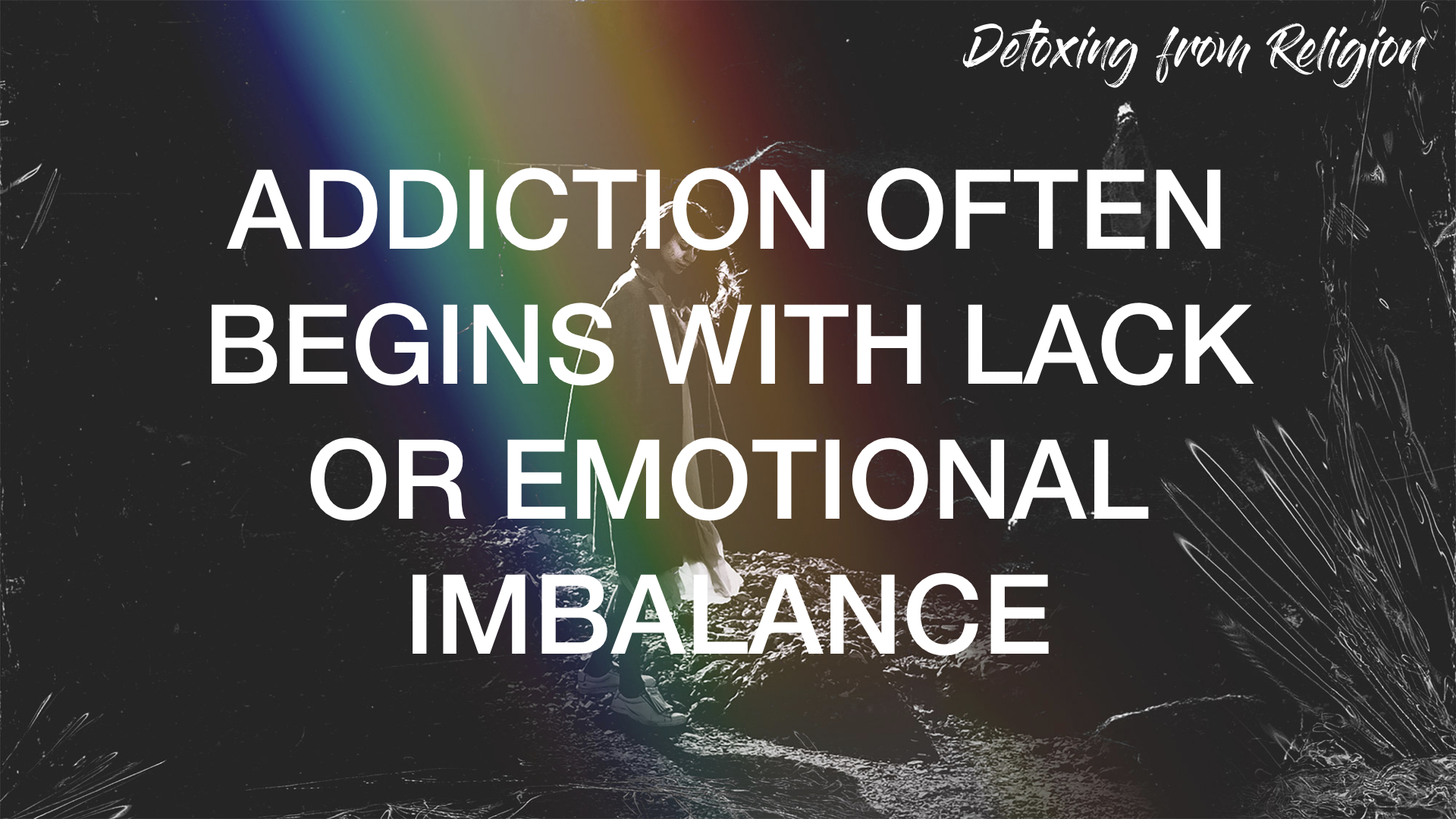
Lack is at the root of addiction. Feeling like something is missing and trying to fill that gap with toxic substances or behaviors is the engine for addiction. We see that same cycle in religion. Religion is the king of causing you to feel like something is missing. Under religion you’re never good enough and you can never do enough to keep God happy. Most people never say it this clearly but they believe that God’s happiness is based on your behavior. This lie is the root or toxic religion.
Toxic religion is the mindset that acceptance or rejection with God is based on how good or bad you are. Religious folks would never say they’re good because of their behavior, but they might say they’re bad or unrighteous because of sinful behavior. That’s just as self-righteous and toxic as thinking your righteous because you kept the commandments.
The solution to breaking the addiction to toxic religion is to find a place of inner balance that’s rooted in Christ’s finished work. Your true, spiritual, eternal identity is complete already. Your standing before God doesn’t change. Only toxic religion believes otherwise, and if you believe God changes his mind about you based on your performance, it’s tine to detox from religion.
Listen to AUDIO
Podcast | iTunes | Spotify
Lack is at the root of addiction. Feeling like something is missing and trying to fill that gap with toxic substances or behaviors is the engine for addiction. We see that same cycle in religion. Religion is the king of causing you to feel like something is missing. Under religion, you’re never good enough and you can never do enough to keep God happy. Most people never say it this clearly but they believe that God’s happiness is based on your behavior. This lie is the root or toxic religion.
Toxic religion is the mindset that acceptance or rejection with God is based on how good or bad you are. Religious folks would never say they’re good because of their behavior, but they might say they’re bad or unrighteous because of sinful behavior. That’s just as self-righteous and toxic as thinking you’re righteous because you kept the commandments.
The solution to breaking the addiction to toxic religion is to find a place of inner balance that’s rooted in Christ’s finished work. Your true, spiritual, eternal identity is complete already. Your standing before God doesn’t change. Only toxic religion believes otherwise, and if you believe God changes his mind about you based on your performance, it’s time to detox from religion.
Homeostasis
In the substance abuse treatment world, the goal is to help people develop homeostasis. Homeostasis is when a person has a healthy inner balance that does not react to environment or triggers with toxic behavior. The medical world realizes that freedom from addiction is a healthy inner condition of peace and control.
Once the body’s dependency on the chemical substance has run its course, the substance abuse rehabilitation world seeks to help the person to develop a healthy balance of emotions and choices inwardly. This is called developing a “constant.” A constant is a healthy state of inner existence that voluntarily and involuntarily responds in a healthy way regardless of environment or triggers.
The goal is the same for the religious addict. We know that the strength of sin is the law. Humans are always seeking justice, even within ourselves, so when we encounter God’s standard, it only serves to reveal our lack. If the person agrees with what the law says they will continue the destructive, sinful behavior. They will take on the identity of a law-breaker in their heart and continue in their sin.
But if that person can admit that they’re powerless over their sin and discover a power that’s greater than sin, they can actually transcend the lure of sin and therefore break their addiction to religion as well.
Religious addiction is rooted in an erroneous belief about God and themselves. For instance, if a Christian still believes they have a sin nature they have an excuse for their sin and will allow themselves to choose sin because they simply think it’s in their nature. But a believer that’s free from the faulty belief of a dual-nature will look to God for a strength to transcend their sinful behavior.
If you believe you’re a sinner by nature, you will continue in sin. If you believe you are righteous by nature, you will choose righteousness.

Christ As Our Constant
“Christ as our constant” sounds like a nice line from an old school hymn but it’s much more than that. It’s a deep psychological statement that touches the core of our identity. The final frontier for the Christ follower is mind-renewal, specifically in the area of who we are in Him.
Consider the following passages from Colossians 2, this is a warning from Paul about a deceitful teaching that’s going around…
8 See to it that no one takes you captive through philosophy and empty deception, which are based on human tradition and the spiritual forces of the world rather than on Christ.
He then gives the proper perspective to correct the error of this “deceitful” teaching…
9 For in Christ all the fullness of the Deity dwells in bodily form. 10 And you have been made complete in Christ, who is the head over every ruler and authority. 11 In Him you were also circumcised in the putting off of your sinful nature, with the circumcision performed by Christ and not by human hands.
To say you’re complete, lacking nothing, already righteous, holy and sanctified is blasphemy to the toxic, religious mindset. That’s because it bases “completeness” on behavior. In now way am I permitting the continuance of sinful behavior, by the way. I’m simply placing the destiny of the believer squarely where Paul does, which is in the death, burial and resurrection of Christ.
The circumcision that Christ performs in you is not on your physical body, it’s at the core of your being as a human. He cuts away the spiritual death, the spiritual cancer that has you destined for eternal separation from God and casts it aside. The truth is he took upon himself that spiritual death for you, which is what actually gives him the power to remove yours.
Staying Free
Your victory over sin and death is found in Christ’s surgery on you. He performs the ultimate procedure and cuts away the very aspect of you that was at enmity with God. He changes you, at your core, forever. Christ gives you a new constant, an eternally healthy condition of homeostasis. Our role is to allow this procedure to affect the rest of our soulish and physical being. The work of Christ within us can permeate and transform those temporary aspects of our being through the spirit he places within us at the time of this spiritual surgery ensures a new identity that can forever desire what God desires unto manifestation. But it can never work the other way around.
Never let toxic religious teaching or thinking, rob you of the work of Christ within you. You can live from this place of power and never again give into the lack and depravity in the world.
Living Forward
Here is a suggested process to take ownership of the work of Christ’s hands within you:
Pick an issue where you struggle physically, mentally or emotionally.
Admit you’re powerless on your own over the issue.
Admit that Christ in you is powerful over the issue.
Ask yourself, “does Christ, who is in me, struggle with this issue?”
Ask, “what do I need to believe about myself to be free from this issue.?”
In other words, what is it that you would believe about yourself if that issue had no power over you? For example, “I’m not afraid of anything.” Or, “I’m not the kind of person that looks at pornography.” Or, “I just never get anxious over anything.”
Identity the healthy belief, as it relates to your new identity in Christ, and own it. Put it on in your mind and emotions. See yourself as the kind of person that doesn’t have that struggle.
The truth is you’re not the kind of person that struggles with sin, you are the righteousness of God in Christ Jesus, having already been cleansed by God (sanctified) and brought to a place of holiness (purity). Who you are at your core, after the surgery of Christ within you, doesn’t have those issues. When you assume that identity, your voluntary and involuntary responses to any given environment or triggers with always consider God and apply his wisdom.
You are truly God’s masterpiece, a testament to the nature and miracle-working power of God. Own it!
For we are God’s masterpiece. He has created us anew in Christ Jesus, so we can do the good things he planned for us long ago. Oneness and Peace in Christ. Ephesians 2:10

Breaking Your Addiction to Self-Righteousness
Righteousness determines how God treats you. There are two kinds of righteousness, the kind that Jesus gives and the kind that religion thinks it can earn or be disqualified for through keeping and breaking laws or commandments.
Religion can become addictive. Religion for the purposes of this article is man’s attempts to be accepted by God based on deeds or rules. It feels good to do the right thing and it feels bad, for normal people, to do the wrong thing. But to think God is changing how he relates to us based on our behavior is a toxic view of God and it invalidates the right-standing with God that Jesus died for. To believe that God withholds blessing, wisdom or love based on behavior is a toxic doctrine of religion that ends up driving people away from God.
Addiction is wrapped up in a false sense of fulfillment of peace based on a substance that’s toxic for you. With addiction, a dependency is developed that might be chemical, emotional, physical or psychological. Being addicted to religion is more psychological and emotional because it’s all about toxic beliefs rather than using a substance.
You would never say self-righteous things like, “I was really good today, now God owes me a blessing.” Or, “I didn’t sin this week so now I’m more righteous.” You would never say those things because you know your righteousness isn’t a result of your behavior, it’s a gift from God through faith in the finished work of Christ.
But you might say, “I wonder what God is doing” when you have a flat tire, lose your job, have marriage problems or contract a disease. That’s still self-righteousness.
How is that self-righteousness? Because thinking God’s blessings are based on good behavior is the same as thinking God’s curses are based on bad behavior, either way it bases your standing with Him and His subsequent treatment of you on your behavior. To be clear, your standing with God (righteousness) isn’t based on performance, it’s based on God’s love for you and his willingness to be a good Father to you.
Thinking that God is allowing bad things due to your behavior is a self-righteous, toxic belief that can become addicting. The brain gets used to trying to understand God through circumstances and automatically asks “why” every time something goes wrong. That’s a mindset that the believer must detox from. You can eliminate that toxic belief by being confident that your right-standing with God is rooted in Jesus’ obedience, no matter what!
Listen to AUDIO
Podcast | iTunes | Spotify
What is Righteousness?
Here’s what we know about righteousness, it’s a free gift, it can’t be earned by self-efforts. It means; as you should be, right with God and nothing held against you.
To have right-standing with God means God is holding nothing against you, so you can’t say, “God why is this happening, what did I do,” if you’re assuming he’s allowing it for some reason. The truth is, God NEVER determines blessings or curses for you based on your performance.
Some of you never say, “God what did I do,” but many folks do. If you don't, praise God, watch the message above and be glad. If you do say or think that sometimes, keep reading.
Quit Asking Why
Quit asking God what he’s doing when things go wrong, it’s not him doing it. Paul and James say the same thing on this issue.
What you hear when you read this next passage is a good test to see how addicted to religious thinking you are…
1 Corinthians 10:13 No temptation has overtaken you except what is common to mankind. And God is faithful; he will not let you be tempted beyond what you can bear. But when you are tempted, he will also provide a way out so that you can endure it.
Did you hear “ God won’t put more on you than you can bear,” or did you hear “when trials and temptations come, God will show you a way out?”
Consider this passage as you answer…
James 1:13 When tempted, no one should say, “God is tempting me.” For God cannot be tempted by evil, nor does he tempt anyone; 14 but each person is tempted when they are dragged away by their own evil desire and enticed. 15 Then, after desire has conceived, it gives birth to sin; and sin, when it is full-grown, gives birth to death.
Keep in mind, earlier in James chapter 1, he says to “count it all joy when you fall into different kinds of temptations” (same word used in verse 13 when James instruction us to never say that the temptation is from God.
James teaches that when the temptation comes, your faith is tested or you’re in a trial. He instructs you to ask God for patience to endure, not for a reason why he’s allowing it. Now, you might learn a lesson as you patiently endure the temptation/test/trial, but James CLEARLY says, don’t say it’s from God!!!
Do You See It Yet?
Ok, here’s the point of this article, to see how addicted you are to religious thinking. Just so we’re on the same page I’m defining religion as “your attempt to be acceptable to God through keeping the rules.” Or “man’s set of rules to keep to be accepted by God.” Jesus called these kinds of rules Pharisaical or hypocritical.
If you heard, “God won’t put more on you than you can bear” when you read 1 Corinthians 10:13, read it again in light of James instructing you to never say the temptation is from God. What this passage is actually saying is that when you find yourself in a trial/temptation, God will show you how to get out of it.
He does this by giving you patience and wisdom. He gives you patience so you don’t take shortcuts and do something unethical or ungodly and he gives you wisdom so you don’t get hurt as you journey through.
Detoxing from Religion
I’ve said all of that to say this, there may be some things you believe about God that are actually toxic beliefs. A toxic belief is something you believe that is actually causing damage in your life. We believe all kinds of toxic things about God that aren’t true. Toxic religious beliefs sound spiritual at times but are always unscriptural.
Here are a few…
God is angry with me because I messed up.
The truth is, God promised that he would never again be angry with you after Christ’s sacrifice because he established an everlasting covenant of peace with Christ on your behalf. (Isaiah 53 and 54).
I still mess up because I’m just a sinner saved by grace.
To detox from that belief, you must understand your new creation identity. You are not a sinner, you are not even half of a sinner, with a dual nature. You are the righteousness of God in Christ Jesus. Which belief promotes sin and which belief promotes righteousness in your outer man?
My life is difficult sometimes because God is teaching me a lesson.
To detox from this belief, you must understand the nature of God and how he treats people. I covered this in my section about 1 Corinthians 10:13 and James 1:13.
Becoming Confident in Righteousness
To detox your mind from a religious addiction you must be firmly rooted in faith-righteousness rather than self-righteousness.
Galatians 2:16 Yet we know that a person is made right with God by faith in Jesus Christ, not by obeying the law. And we have believed in Christ Jesus, so that we might be made right with God because of our faith in Christ, not because we have obeyed the law. For no one will ever be made right with God by obeying the law.” 17 But suppose we seek to be made right with God through faith in Christ and then we are found guilty because we have abandoned the law. Would that mean Christ has led us into sin? Absolutely not! 18 Rather, I am a sinner if I rebuild the old system of law I already tore down. 19 For when I tried to keep the law, it condemned me. So I died to the law—I stopped trying to meet all its requirements—so that I might live for God. 20 My old self has been crucified with Christ. It is no longer I who live, but Christ lives in me. So I live in this earthly body by trusting in the Son of God, who loved me and gave himself for me. 21 I do not treat the grace of God as meaningless. For if keeping the law could make us right with God, then there was no need for Christ to die.
I circle back around to the first few lines of this article, it’s improper and unbiblical to ask God what you’ve done wrong for him to allow a curse, tragedy or difficulty into your life. It denotes that God is relating to you based on your bad behavior. It actually attempts to paint God as unjust, but that’s another topic.
The next time you face tragedy, don’t ask why. The God at his word and look for the way out because God promises that when you’re tempted or tested, he’ll show you the way out of it. This does not suggest that you don’t reap what you sow, because you do. And it does not invalidate any persecution you may experience for proclaiming the Gospel, which is different than tests and trials. I’m simply suggesting you think the way God thinks, and trust him for a way of escape from temptation rather than try to understand his will through the circumstance. He’s a good father that desires to bless you, protect you, provide for you and give you his life, allow him to do so by letting him off the hook for the troubles in your life.
