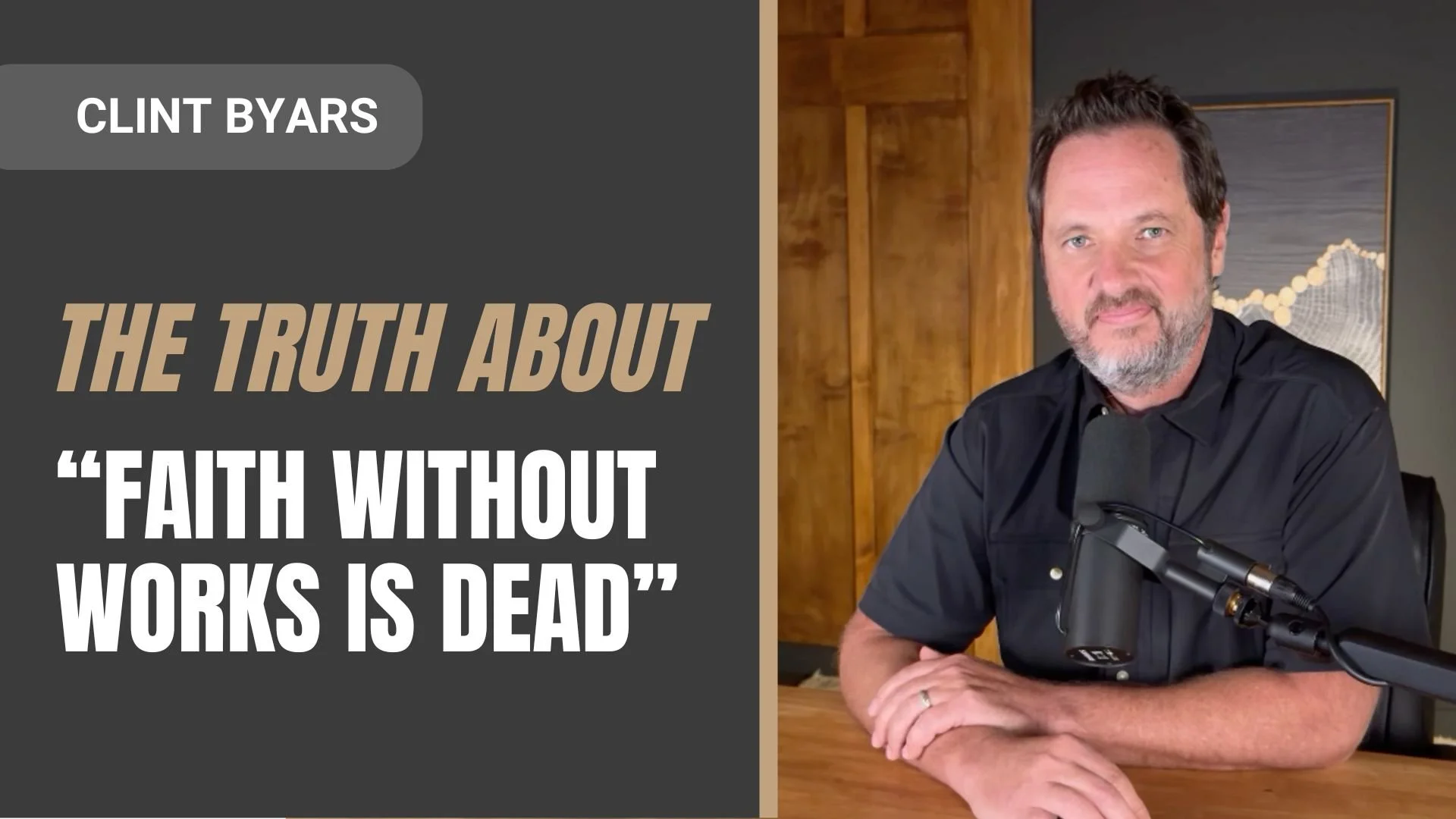
A Prostitute Clears up the Confusion with “Faith Without Works Is Dead”
Few passages generate more confusion, fear, or theological argument than James’s statement: “Faith without works is dead.” For centuries people have read that line and immediately imagined a spiritual equation where faith alone is not enough, as if salvation rests on some blend of belief and moral performance. But that’s not what James is arguing. James is not correcting Paul, he’s not redefining the gospel, and he’s not creating insecurity about salvation.
Subscribe to my YouTube channel: https://www.youtube.com/clintbyars?sub_confirmation=1
“For as the body without the spirit is dead, so faith without works is dead also.”
Faith Without Works Is Dead — Understanding James Through the Lens of Grace
James’s famous statement—“faith without works is dead”—has intimidated and confused Christians for generations. Many read it as if James is challenging the core of the gospel, implying that salvation is somehow a combination of faith plus moral performance. Others use it to examine themselves anxiously, wondering, “Do I have enough works to prove I’m saved?”
But none of that reflects what James was actually saying.
James agrees with Paul. He’s not reshaping the gospel. And he’s not creating a system of assurance where believers must constantly measure their fruit to determine if they belong to God. James is speaking as a pastor to a struggling community of believers, urging them toward maturity, action, and a living faith that participates in God’s purposes.
To understand his tone and message, we have to start where the gospel starts.
Faith Doesn’t Save You. Jesus Saves You.
People often say, “We’re saved by faith,” but that’s shorthand. The actual saving power is Christ Himself—His death, burial, resurrection, and His ongoing work through the Holy Spirit.
Faith is not a force and not a contribution.
Faith is a response.
What makes salvation available is Jesus’ atoning work.
What makes salvation effective is the Holy Spirit regenerating the believer.
When we trust Jesus, God works in us. He makes us new, gives us a new heart, unites us with His Spirit, and adopts us as His children. All of that happens before any works appear in our lives.
Once God has done this inward work, good works naturally become the fruit of salvation—not the requirement for it.
James assumes this. He writes with the understanding that his audience is already saved, already indwelt by the Spirit, and already part of God’s family. His concern is not their salvation but their productivity as followers of Christ.
The Audience James Addressed
James opens his letter by addressing “the twelve tribes scattered abroad” (James 1:1)—Jewish believers displaced from Jerusalem after persecution broke out in Acts 8. They were living under pressure, poverty, instability, and social displacement. These circumstances created spiritual challenges. Their behavior didn’t always match their faith, and their community life reflected immaturity.
James isn’t writing to skeptics or outsiders.
He is writing to believers who truly trusted Christ but were struggling to follow through.
They were having trouble:
caring for the poor,
controlling their words,
remaining impartial,
resolving internal conflicts,
living consistently with their new identity.
James’s letter is pastoral in nature—firm, direct, corrective, and filled with urgency. He’s not trying to unsettle their assurance; he’s trying to stir them awake.
James’s Tone: Direct, Honest, Pastoral
James writes like a pastor who loves his people enough to challenge them. You can hear the weight of his concern in the cadence of his words. At times he sounds frustrated—not because he doubts their salvation, but because he longs to see their faith become active, vibrant, and outwardly impactful.
His tone comes through clearly in lines like these:
“Be doers of the word, and not hearers only.”
“My brothers, these things ought not to be so.”
“Why are there wars and fights among you?”
“You have not because you ask not.”
“Draw near to God… Cleanse your hands… purify your hearts.”
These aren’t condemnations.
They are exhortations.
James is not saying, “I don’t think you’re saved.”
He’s saying, “Come on—you’re saved, so let your faith matter in real life. Let it show up.”
His frustration is the frustration of spiritual care, not spiritual suspicion.
What James Is Actually Addressing
James is dealing with believers whose faith has become inactive—unexpressed, unfruitful, dormant. They believe the right things about Jesus, but their actions haven’t caught up to the life they’ve been given.
His message is simple:
Faith is meant to move.
Not to earn salvation.
Not to prove salvation.
But because the Spirit of God lives within us and compels us toward love, mercy, compassion, and obedience.
When James says “faith without works is dead,” he’s not describing a false believer headed for hell. He’s describing a believer living beneath their calling—someone whose faith has stopped producing anything meaningful.
Dead faith is not nonexistent faith.
Dead faith is inactive faith.
His goal is activation, not accusation.
Why James Uses Abraham and Rahab
To make his point, James brings up two powerful Old Testament examples—Abraham and Rahab—both of whom demonstrate that faith righteousness has always been God’s pattern.
Abraham Already Had Righteousness Before His Work
Abraham was declared righteous in Genesis 15, long before he offered Isaac on the altar in Genesis 22. His willingness to offer Isaac wasn’t the root of his righteousness; it was the fruit of it. Abraham was acting out of a deep persuasion of God’s promise. He wasn’t proving himself to God; he was responding to God with trust.
Rahab Demonstrates Faith in the Middle of Her Brokenness
Rahab is perhaps the clearest picture in the Old Testament of faith righteousness. She’s still identified as “Rahab the harlot” when she receives the spies. She had not cleaned up her life or reformed her behavior before her act of faith. She simply believed what she heard about the God of Israel and acted on it.
Her works followed her belief, not her reform.
Her faith preceded her transformation.
Rahab isn’t celebrated because she achieved moral perfection; she’s celebrated because she trusted God. That’s what justified her, and that’s why she appears in Hebrews 11.
James uses her as an example precisely because she proves that faith produces works, not righteousness.
Faith Produces Works, Not Salvation
James’s whole argument can be understood this way:
Faith is the internal persuasion of God’s grace.
Works are the outward expression of that persuasion.
Salvation rests entirely on Christ’s finished work.
Works flow from the new creation that salvation produces.
James is calling believers to let their faith become visible in love, mercy, patience, generosity, and action. He is not trying to make them question their standing with God. He is challenging them to walk in the life they’ve already been given.
When we read James through the lens of the gospel, his message becomes empowering rather than intimidating:
You don’t work to get saved.
You work because you’re saved.
Faith is the root.
Works are the fruit.
The life of Christ in you is what produces both.
Rest easy my friend, if your trust is in Christ for your salvation, you’re saved.
FREE SERIES - Detox from Religion
In this series, I define religion as "your attempt to approach and be acceptable to God through your own efforts." You would never say you are righteous through good behavior, but you might say you are unrighteous through sinful behavior. Both are legalistic and TOXIC.
The challenge with overcoming Toxic Religion is the same as overcoming any addiction, if you take on the identity of the sin, you’ll repeat it, if you take on the identity of someone who doesn’t have that problem, you can walk away from it.
Toxic Religion is focused on sin, failure, guilt, and condemnation. Toxic Religion assumes that you’re evil and you can never do enough. Toxic Religion keeps you focused on the old man and never fully puts on the new man. Toxic Religion will leave you continually seeking God for forgiveness and never truly resting in the peace that salvation by grace through faith should bring. Toxic Religion is addictive and must be cleansed from your identity.
Is God controlling everything?
Does God do evil?
Can you fully trust God?
In this series, I define religion as "your attempt to approach and be acceptable to God through your own efforts." You would never say you are righteous through good behavior, but you might say you are unrighteous through sinful behavior. Both are legalistic and TOXIC.
The challenge with overcoming Toxic Religion is the same as overcoming any addiction, if you take on the identity of the sin, you’ll repeat it, if you take on the identity of someone who doesn’t have that problem, you can walk away from it.
Toxic Religion is focused on sin, failure, guilt, and condemnation. Toxic Religion assumes that you’re evil and you can never do enough. Toxic Religion keeps you focused on the old man and never fully puts on the new man. Toxic Religion will leave you continually seeking God for forgiveness and never truly resting in the peace that salvation by grace through faith should bring. Toxic Religion is addictive and must be cleansed from your identity.
Religion is an addiction because addiction attempts to meet a need that is actually, at its root, an inner imbalance of some kind, whether it be physical or psychological. Religion seeks to meet that imbalance through rule-keeping or obsolete covenant restrictions.
To break any addiction the inner man must reach a place of healthy homeostasis so it can involuntarily regulate toward health (I cover this idea in this series). The toxicity of religion is that it says you’ll always be imbalanced, never finding homeostasis because you are flawed at your core, therefore perpetuating toxic behavior.
In this series you’ll learn how to:
Break free from your addiction to self-righteousness
Live from inner balance
Trust God with your heart
Know God’s true character
Build your faith on TRUTH rather than CIRCUMSTANCE THEOLOGY
In this series I address a few examples of toxic beliefs like these:
God is angry with me because I messed up. How to detox from that belief - God promised that he would never again be angry with me after Christ’s sacrifice because he established and everlasting covenant of peace with me through the finished work of Christ. (remember, toxic beliefs drive toxic behavior, what behavior do you think this toxic belief will drive?) This is actually self righteousness
I still mess up because I’m just a sinner saved by grace. To detox from that belief you must understand your new creation identity. (what behavior do you think this belief will drive?) It’s actually
Matthew 23:25 “Woe to you, teachers of the law and Pharisees, you hypocrites! You clean the outside of the cup and dish, but inside they are full of greed and self-indulgence. 26 Blind Pharisee! First clean the inside of the cup and dish, and then the outside also will be clean.
My life is difficult sometimes because God is teaching me a lesson. To detox from this belief you must understand the nature of God and how he treats people.
If you feel like God is angry with you or you’re always questioning circumstances through your skewed perspective of God’s sovereignty, you’ll feel like you’re doing something wrong when you begin to think a different way. Let me help you break free from Toxic Religion!! It’s time to KICK THE HABIT OF BLAMING YOUR PROBLEMS ON GOD and discover your freedom in Christ!












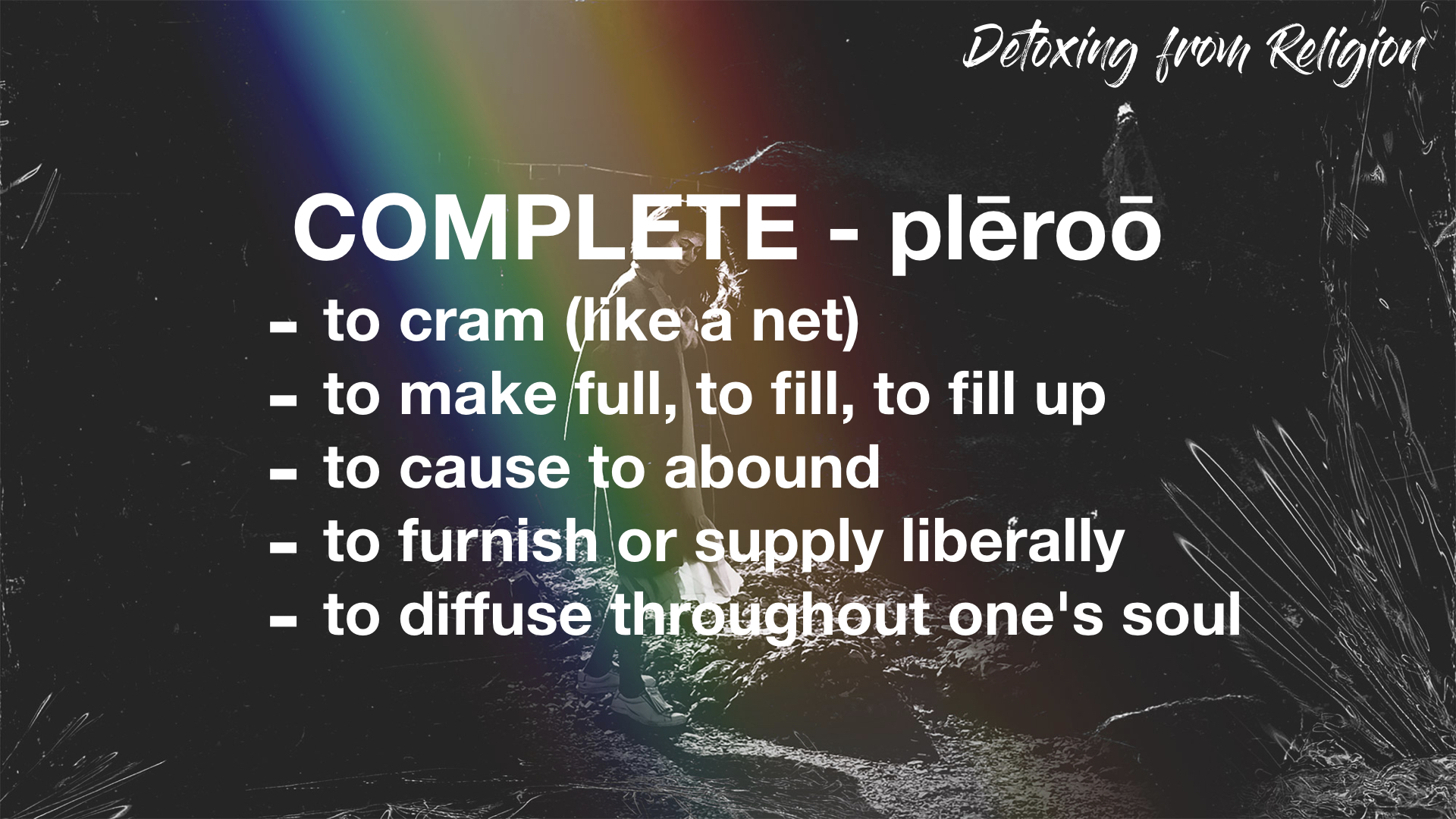





















Lack is at the root of addiction. Feeling like something is missing and trying to fill that gap with toxic substances or behaviors is the engine for addiction. We see that same cycle in religion. Religion is the king of causing you to feel like something is missing. Under religion you’re never good enough and you can never do enough to keep God happy. Most people never say it this clearly but they believe that God’s happiness is based on your behavior. This lie is the root or toxic religion.
Toxic religion is the mindset that acceptance or rejection with God is based on how good or bad you are. Religious folks would never say they’re good because of their behavior, but they might say they’re bad or unrighteous because of sinful behavior. That’s just as self-righteous and toxic as thinking your righteous because you kept the commandments.
The solution to breaking the addiction to toxic religion is to find a place of inner balance that’s rooted in Christ’s finished work. Your true, spiritual, eternal identity is complete already. Your standing before God doesn’t change. Only toxic religion believes otherwise, and if you believe God changes his mind about you based on your performance, it’s tine to detox from religion.