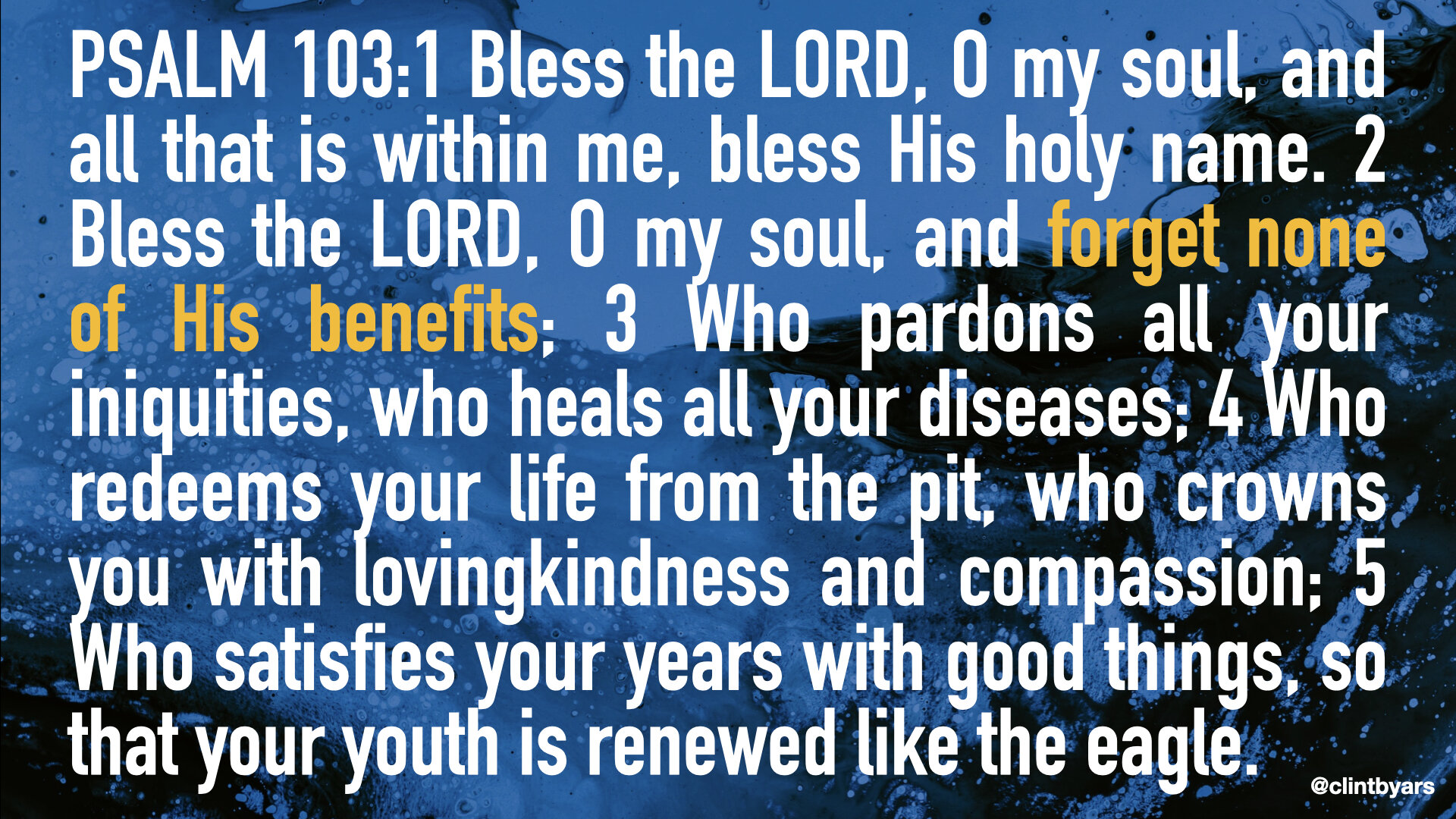
“Bless the LORD, O my soul; all that is within me, bless His holy name. Bless the LORD, O my soul, And forget none of His benefits...”
The world’s systems can fall apart in a matter of days. Things we depend on can crumble overnight. Then what? What do you do if you lose everything? Answer: Remember the Lord and forget not his benefits. God sees ahead and makes provision, and our job is to stay receptive to him, so we’ll follow his leading into provision.
It may take a while, and you may have some problematic days or even years. You may have to work a job you don’t like for a while. You might lose your pension/retirement. But the Lord is with you and can do exceedingly above all you can ask or think.
Be wise, plan, save, invest, but remember those things are not your provision; they are simply tools to manage the Lord’s provision.
The reason we don’t cling to God and allow him to lead us through adversity into extravagant blessing is we get scared and forget about his benefits and lean to our own strength in the process.
We become afraid or get mad at God that we’re going through adversity and harden our hearts to his spirit. We constrict the flow of his blessings by focusing on our problems and making them bigger them him.
It’s the principle of the sower, and the seed from Mark 4, the receptivity of your heart to God’s word determines the degree of his kingdom you’ll experience in this earth. (more on that topic here)
You have the responsibility to believe and co-labor with God. BUT REMEMBER!! You are not limited to your ability. You are not limited to what’s in your hands. You have God’s faith working in you. But that doesn’t absolve you from believing. It’s a collaboration, so don’t forget his benefits.
“Blessed be the Lord, Who daily loads us with benefits, The God of our salvation!”
Life happens while you’re waiting for those benefits to manifest. You have legitimate needs now, I get it. I have friends in the airline industry whose jobs are uncertain. They have not worked in months, and there seems to be no definitive return date.
I have pastor friends who have to relocate because they cannot make their building payments. The chef who has a fantastic restaurant next to our church has to move because the response to the virus killed his business. Life happens, and it’s not always loaded with God’s benefits.
But if you’ll remember, if you’ll keep our hearts open to him, if you’ll hold his promises in your heart and doubt not, you will see his provision. God is always speaking, and he is still leading you into truth and blessing, make sure you are not clouded with fear. Factor God into your life’s decisions. Click for an article entitled “God Is Constant In A World Full Of Variables.”
What Are His Benefits?
If you’re not supposed to forget his benefits, you have to know what they are in the first place. Start with his NAME. God is who he is, and he always behaves in a way that’s consistent with his character.
Check out this list of God’s names to remind yourself of who he is. If you remember who he is, it will help you remember his benefits, they’re the same.
Psalm 103 is another place where he lists his benefits. Let’s walk through the first five verses to learn how NOT to forget God’s benefits.
1 Bless the LORD, O my soul; all that is within me, bless His holy name.
David is speaking to himself, his own soul. He steps outside of his situation to instruct himself to bless the Lord with all that is within him. This is an exercise in repentance, he’s changing the way he thinks about his present situation, and himself, to direct his mind and heart to the Lord.
2 Bless the LORD, O my soul, And forget none of His benefits;
David refines his own instructions to focus on God’s benefits. When David is facing adversity, he chooses to focus on God’s promises and praise him from a different perspective.
3 He who forgives all your iniquities and heals all your diseases,
ALL!! Even under the Old Covenant, David knew God was merciful and forgiving. These are specific promises David is holding on to. He takes the time to remind himself of God’s character.
4 who redeems your life from the Pit and crowns you with loving-kindness and compassion,
David shifts from specific benefits like healing and forgiveness to more poetic and emotional benefits. God will lift you out of the hole, and he will deliver you from darkness, he will save you from the pits of life.
He also gives you a beautiful picture of God’s attitude toward you as he is healing you, forgiving you, and lifting you out of the pit. God does these things with kindness and compassion toward you. God didn’t have to reveal his heart toward us, but he did. He wants us to know how he feels about us as he forgives us. He loves you and wants to be kind to you.
You can use this as a meditative exercise. What does it feel like for the Lord to crown you with his love? How does he do that? What does his kindness feel like as it rests upon your head?
I love poetic moments like this in God’s word. They help us transcend our issues and step into God’s heart for us.
5 who satisfies you with good things, so that your youth is renewed like the eagles.
Keep in mind, David is reminding himself of who God is and how he relates to him. He’s repenting. He’s changing his mind and getting a grasp on his emotions, framing his inner world with God’s character and promises. David knows that the Lord is good, and he desires to strengthen us.
How can you apply what King David models to us in Psalm 103? How can you remember God’s benefits to transcend the emotions of your circumstances? What do you know about God that you can set your mind on and see manifest in your life? David didn’t just quote scripture. He spoke things to himself that are true about God, and then he experienced them. He held on to God’s character until he experienced the very things he knew about God.
Don’t give up, hold fast to God’s character, and he will renew you and load you with benefits. I recommend writing your own Psalm of self-encouragement. Instruct yourself to think on the Lord, include things you should remember. Then expect to see those things in your life, because the Lord is for you!

Attending Pete's funeral reminded me that the Church is at its best when it feels like family, where people are deeply known and genuinely loved. When we love one another the way Christ has loved us, we give the world a reason to say, "I want to be part of that family."
The cross is the lens everything else should be filtered through, and your real fight is usually with a destructive thought loop, not an outside force — so when a hard thought hits, name it and replace it with truth (rejection with acceptance, guilt with forgiveness, shame with grace). Isaiah 53 spells out that trade in detail, showing how his suffering directly answers your specific struggles. And don't keep asking "what's wrong with me" — your mind finds whatever evidence you keep hunting for, so choose to see your same circumstances through a hope-filled lens instead.
A mystical placebo is any ritual, special anointing, or spiritual condition inserted between you and what Christ has already provided — and like a sugar pill in a clinical trial, it can appear to work because your faith and expectation finally had somewhere to land, not because the ritual itself had any power. The trap is that you walk away dependent on the mechanism instead of the source, endlessly chasing the next evangelist, the next formula, or the next loophole to unlock what Jesus already paid for in full. Mature faith cuts through all of it — rooted in the finished work of Christ, it simply recognizes that healing, freedom, and abundant life aren't rewards you earn through the right spiritual steps, but a reality you receive by becoming fully persuaded that he who promised is faithful.
Through the death, burial, resurrection, and Pentecost, God made it possible not only to forgive us but to remove our old sinful nature, give us a new heart, place His Spirit within us, and make us new creations in Christ. Because God's Spirit now lives in us, we are no longer victims of our thoughts but have the ability to bring every thought captive and evaluate it in light of what Jesus accomplished through His obedience on the cross. Lasting transformation happens when we consistently replace thoughts that contradict the Gospel with the truth of who God is, what Christ has done, and who we now are in Him.
A deep dive into declassified FBI “Flying Disc” files reveals a strange mix of military reports, civilian sightings, alleged crash recoveries, and growing public fear during the late 1940s. The documents show that while many reports were likely explainable, the FBI and military still took the phenomenon seriously enough to investigate, catalog, and quietly coordinate responses across the country.
A healthy mother creates a healthy atmosphere. In this heartfelt Mother’s Day message, Pastor Clint Byars shares personal stories, biblical encouragement, and practical wisdom on emotional health, identity in Christ, parenting from peace instead of fear, and why your children need you grounded, stable, and thriving in your relationship with God.
Trials are a real part of life, but James makes it clear that they are not from God—using the same Greek word in James 1:2 and 1:13 to show that while we face them, we must never attribute them to Him. God works in us inwardly, testing and strengthening our hearts, but external trials come from living in a fallen world, not from His hand. Because of that, you can rest in His goodness, stop blaming Him for hardship, and confidently trust that in every trial, He is faithful to provide a way out.
If you don’t experience what Jesus went through for you, you’ll never fully live in what He’s offering to you. Psalm 22 gives us a prophetic window into the suffering of Christ—not just what happened, but what He felt—so that when you see it personally, grace becomes real, freedom becomes natural, and His resurrection life begins to flow through you.
What if the issue isn’t whether God is willing—but whether we actually know what’s been freely given to us?
Prayer is not asking a distant God to respond while you wait and wonder what He’ll do. It’s becoming aware of what He has already said, what Jesus has already finished, and what is already yours in Christ. Most of us start from the problem—what we see, what we feel, what isn’t changing—but real prayer begins from a different place: Christ in you, the hope of glory.
What if the issue isn’t whether God is willing—but whether we actually know what’s been freely given to us?
Prayer is not meant to be a fearful attempt to convince a distant God to care. It is a relational response shaped by what He has already said, who He has revealed Himself to be, and what Jesus has finished. When you let the Word of God move from information into your heart, it begins to expose fear, silence lies, and replace uncertainty with confidence. Real transformation doesn’t happen by asking harder—it happens when the Word becomes living in you.
Many believers were taught to think of prayer as presenting requests to God and waiting to see whether He decides to act. But when you begin to understand the finished work of Christ, prayer starts to look different. Prayer is not asking a distant God to fulfill a request and then wondering if He will answer. Prayer is persuading our hearts of who God already said He is, what His Word promises, what Jesus accomplished at the cross, and who we now are in Christ—then speaking confidently from that place of relationship with Him.
Perfect love is not flawless behavior but mature, complete love that brings the heart into wholeness and casts out fear. When we fully receive and experience God’s love—especially in light of Christ’s finished work—we gain boldness before God, freedom from torment, and the security to love others without defensiveness or resentment. As His love ripens in us, fear loses its grip, relationships heal, and we become stable, joy-filled witnesses of His grace in the world.
This message dismantles the hierarchy mindset in church by grounding everything in the New Covenant reality that “Christ in you, the hope of glory” (Colossians 1:27) and that “the anointing… abideth in you” (1 John 2:27)—not on a few leaders, but in every believer. Offices and gifts are real, but they are expressions of the same Spirit “worketh all in all,” given “to every man to profit withal” (1 Corinthians 12:6–7), so we don’t strive for special anointings or permission structures. The call is simple: stop obsessing over calling labels and go bear fruit—live organically from union with Jesus, love God, love people, and let the Spirit weave the body together through what “every joint supplieth” (Ephesians 4:16).
Jesus didn’t call us servants—He called us friends. This message explores how the Holy Spirit leads believers plainly, not through control or hierarchy, and why elevating authority over relationship creates confusion instead of freedom.
In John 14–17, Jesus repeatedly connects the manifestation of God’s presence to keeping His commandments—but He defines those commandments as loving God and loving people, rooted in the truth that “We love Him because He first loved us.” When heard as a servant, His words sound conditional and legalistic; when heard as a friend, they become a relational invitation where obedience flows naturally from being loved. Love is not permissive but transformative—it grounds us, fills us with joy and peace, produces unity that reveals Christ to the world, and creates the very environment where His Spirit works most powerfully.
Jesus said the Holy Spirit takes what belongs to Him and declares it to us. This message explores how Christ’s authority is shared, not withheld—and how we learn to live from it.
Jesus doesn’t relate to you as a servant trying to figure Him out. He calls you a friend. And a friend knows what the Father is doing. Confusion isn’t a sign God is withholding—it’s an invitation to renew your mind and live from the identity Jesus already gave you.
Jesus was angry with religious leaders who made following God difficult. He never intended faith to be heavy, confusing, or exhausting. When Jesus said, ‘My yoke is easy and My burden is light,’ He was inviting us into a shared life with Him—one where He carries the weight. Life itself isn’t always easy, but following Jesus is meant to be. When we let Christ bear our burdens, we become people who lift burdens off others instead of placing them on their shoulders. That’s who we are—we are burden lifters.
God never intended to relate to His people through fear, distance, or endless mediation. From the beginning, His desire was simple: to be with us. In this message, we behold the majesty of Christ—not as a distant ruler, but as Emmanuel, God with us. By contrasting Mount Sinai with Mount Zion, law with grace, and instruction with encounter, we rediscover the heart of the gospel: blessing before behavior, gratitude before striving, and intimacy before obedience. When we see God clearly through Jesus, fear loses its grip, identity is restored, and transformation flows naturally from knowing we are righteous, accepted, and deeply loved.
Many people have heard part of the gospel, but not the part that actually changes life. This teaching unpacks how the kingdom of God works like seed in the heart, why the Holy Spirit—not performance—is the power source, and how fixing our eyes on Jesus leads to lasting transformation.
Christmas is the announcement that God planted His kingdom in the earth. It is the declaration that heaven stepped into humanity, not to observe it from a distance, but to heal it from the inside out. When Jesus was sent, the kingdom was not postponed to a distant future—it was inaugurated. And as we honor Him, behold Him, and glorify Him, we experience both Him and His kingdom growing within us.
Jesus did not come merely to forgive sin or prepare us for heaven someday—He came to bring the kingdom of God into the earth now. The kingdom is not distant, future, or external; it has been planted, it is increasing, and it is meant to be lived from the inside out. When Christ reigns in the heart, He reshapes the mind, restores identity, and produces righteousness, peace, and joy through the Holy Spirit. We are not waiting for the kingdom—we are participating in its growth by changing how we think, guarding our hearts, and learning to live from the reality Jesus brought.
Few passages generate more confusion, fear, or theological argument than James’s statement: “Faith without works is dead.” For centuries people have read that line and immediately imagined a spiritual equation where faith alone is not enough, as if salvation rests on some blend of belief and moral performance. But that’s not what James is arguing. James is not correcting Paul, he’s not redefining the gospel, and he’s not creating insecurity about salvation.
Your words reveal the atmosphere of your heart, and gratitude is one of the fastest ways to change that inner environment. When thanksgiving rises first, peace begins to guard your emotions, your thoughts, and eventually your speech. As you intentionally practice Philippians 4:8–9 toward the people in your life—seeing what’s true, noble, lovely, and of good report—your reactions soften, your perspective shifts, and your relationships become places where the love of Jesus can actually be felt.
Jesus expected His disciples to read themselves into the miracle of the loaves—to let His provision reshape how they saw themselves and what they believed He would do for them. Instead, they slipped back into fear. We often do the same thing in our relationships. Luke 6 shows us how easily we judge people by assuming their motives, especially with family, and that judgment always multiplies back into more conflict than we ever intended. The blog calls us to interrupt that cycle by using Philippians 4. Pick someone you’ve had tension with and choose to think on what’s true, lovely, admirable, and honorable about them. When you do, you break the judgment loop, heal your reactions, and let the peace of God lead your heart.
When you’re facing something you feel the desire to pray about, ask yourself; Where is Jesus and who is Jesus in this situation? Are there any promises I can stand on and speak? What miracle of Jesus am I meditating on to persuade my heart of his power, character, and will in this situation?
Break the fear of making a wrong move. You’re not waiting on God—He’s waiting on you. Commit (roll) your works to the Lord (Proverbs 16:3), act from your new identity, and watch Him establish your plans as you walk in love.
You’re not waiting on God—He’s waiting on you. “You’ve got ministry in you. You’ve got passion in you. You’ve got family tree changing mornings in you.” The Father’s heart is clear: “Commit your works to the Lord, and your thoughts will be established” [Proverbs 16:3]. It’s time to make a plan, take a step, and trust Him to guide the way.
Too many believers think they’re waiting on God, but the truth is God is waiting on us. Romans 8:11 says the same Spirit who raised Jesus from the dead dwells in you, giving life and power right now. You don’t lack anything. The future isn’t someday—it’s now.
So many believers live stuck—waiting for a move of God, waiting for a prophecy, or waiting for a leader to tell them what to do. But the truth is, Jesus is your breakthrough. You’re not waiting on Him to act; He’s already given you everything you need for life and godliness. The problem isn’t that God is withholding—it’s that confusion and control have clouded your vision. In this message, Breaking Free from Confusion and Control, we’ll look at Proverbs 2:1–2 and Hebrews 11:11 to see how to incline your ear, apply your heart, and judge God faithful. Freedom starts when you stop waiting and start walking in who you already are in Christ.